03 June 2010
London Museums, Part One: Science, Natural History, and the British Library
London is a museum junkie's paradise: the city is home to nearly a dozen world-class museums . . . and nearly all of them are free! What's more, any one of London's mega-museums is simply too huge to cover in one visit, let alone in one section of a blog post, so what you'll find below are just the highlights. Enjoy!
Science Museum
The Science Museum is one of a cluster of enormous museums on Exhibition Road in South Kensington--it shares a block with the Natural History Museum (see below) and the Victoria and Albert Museum (upcoming post).
For the most part, the Science Museum is a pretty typical sort of "science center," with interactive exhibits on things like physics, astronomy, space travel, and such. For Nana and me, what made the Science Museum unique were its two historical exhibits.
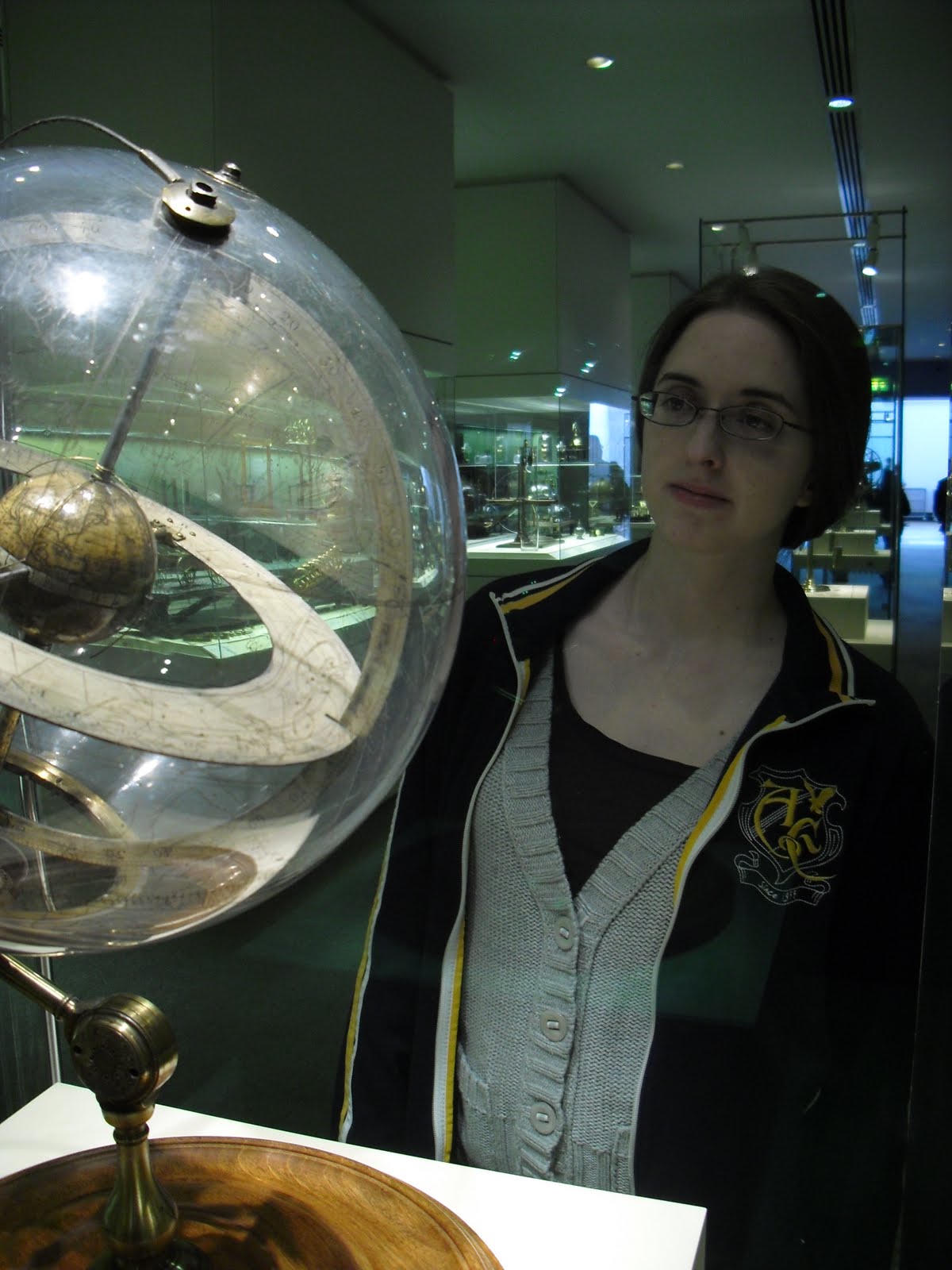
One of these was a large collection of 18th-century scientific equipment, such as the orrery you see above. (An orrery is a device for modeling the motion of the Earth and the solar system.) The collection included many items intended more for display--one might even say performance--than for active experimentation, as one of the great legacies of science in the 18th century was its increasing popularization. In a sense, these items represented the "science museums" of two-and-a-half centuries ago.
The other historical exhibit (too dim for photos, I'm afraid) was on the Golden Age of Islam. During this period, from roughly 750 AD to the Sack of Baghdad in 1258, scholars in the Middle East, North Africa, and Muslim Spain made major contributions to knowledge in general, and especially to science in particular. In fact, many aspects of the scientific method itself can be traced back to these scholars, and their names live on in words such as, for example, "algebra" and "algorithm," just to name a few.
Natural History Museum
The Natural History Museum is famous for two things: architecture and dinosaurs.
Architecture first. The Natural History Museum is sometimes called a "cathedral of nature," and rightfully so, it is housed in a remarkable Victorian behemoth of a space.
The interior is just as impressive as the exterior, with high vaulted ceilings, echoing hallways, and loads of unexpected detail, like the carving below.
Like most of London's museums, the Natural History Museum would take several days to explore fully. We naturally blew right past the geology exhibits . . .
. . . and headed straight for the dinosaurs. As expected, the dinosaur rooms were swarming with giddy schoolchildren, and probably out of consideration for these guests, most of the skeletons on display were reproductions. But all those little smiles disappeared when confronted with the museum's life-sized animatronic T-rex ("life-sized animatronic T-rex" being the coolest phrase you'll read today).
Just. Awesome.
British Library
The British Library in St. Pancras is, first and foremost, a research library--one of the world's greatest, at that. But like most research libraries, they also have a small exhibition space for showing off the collection. Given that, a) I love books, and b) I love maps, the decision to spend an hour at the BL's "Magnificent Maps" exhibit.
I'll spare you a long lecture (maybe Nana the geography teacher will want to chime in with a comment) and just tell you that you can see a couple highlights on the exhibition website, including a fantastic medieval world-map with east at the top and Jerusalem at the center and a fanciful modern map imagining London as a vast urban island. Very cool!
31 May 2010
Train to London
Busy times here at the Educated Burgher, so here are a few quick shots of the train trip we took to London a couple weeks ago. More London posts to follow!
Such a civilized way to travel, isn't it? That yellow out there is canola (aka, rape), which is grown through large stretches of northern Europe. It flowers in May, turning huge swaths of the countryside a brilliant, very unnatural-looking yellow.
The East Coast trains also skirt the North Sea between Edinburgh and Newcastle, which makes for some spectacular views. Unfortunately, ours was a morning ride, so the low sun prohibited any pictures. Alas!
Such a civilized way to travel, isn't it? That yellow out there is canola (aka, rape), which is grown through large stretches of northern Europe. It flowers in May, turning huge swaths of the countryside a brilliant, very unnatural-looking yellow.
The East Coast trains also skirt the North Sea between Edinburgh and Newcastle, which makes for some spectacular views. Unfortunately, ours was a morning ride, so the low sun prohibited any pictures. Alas!
28 May 2010
Let's Go Wolves!
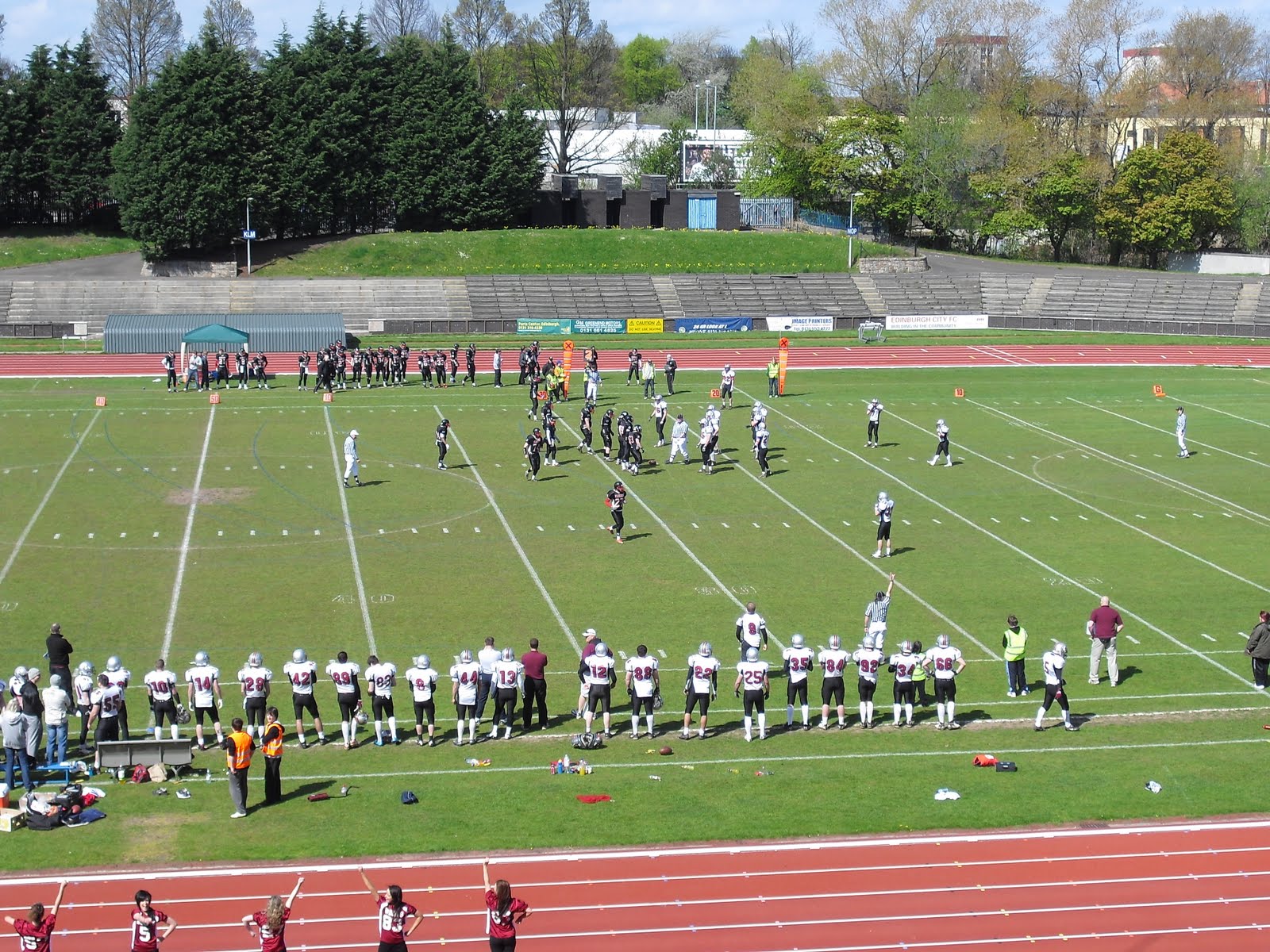
Justin and I are huge football fans, and yet we have not seen a football game in person over five years. We rarely even get to see the televised games live, because of time zones. It was therefore with great excitement that we discovered the British American Football Association and our local team, the Edinburgh Wolves. Brimming with anticipation, we set out for the May 8 game at Meadowbank Stadium against the Highland Wildcats:
The Wolves are not an NFL team. They're not even a D1 college team, or a really good high school team (they don't even list a punter or kicker on the roster... and it unfortunately shows on special teams). What they are is a bunch of guys who love to play the game so much that they're not only unpaid, they actually contribute money to keep the team going. Tickets cost just three pounds, down from five (they said it's to help their fans in the recession). Hence the old-school scoreboard:
The stands look pretty empty here but there were people in front of us. Maybe 100 - which means individual fans are audible on the field. I wish I could say I didn't use this power for evil, but the truth is we cheered and heckled so loudly that the commentators asked if we could come back for another home game. (Duh!)I firmly believe our enthusiastic support carried the Wolves to this stirring final 22-13 victory:
Let's Go Wolves!
24 May 2010
Canadian Kilt Kerfluffle (via BoingBoing)
BoingBoing has posted a story about a high-school senior in Alberta who was denied permission to wear a kilt to his graduation. The student is of Scottish extraction, and his principal appears to be completely unaware of or sympathetic to a style of formal dress common not only in Scotland but across Canada, too.
Then again, kilts are kind of hilarious.
22 May 2010
Scottish scenery
Justin and I usually focus on pictures of us. Partly, that's because we have grandmas reading this blog, and they're more interested in pictures of us than in pictures of scenery that you could find anywhere. It's also because I'm vain. In any case, I realized we had some nice scenic shots we hadn't shared. Photo credit on just about all of these goes to Justin. I'm pretty sure we haven't posted any of these before, but my apologies if it's a repeat.
Sunrise from Arthur's Seat, Edinburgh, October 2009
Snow on Holyrood Park, Edinburgh, January 2010
View from Mar's Wark, Stirling, December 2009
Mountains, possibly Trossachs, from Stirling, December 2009
Sunset from Stirling Castle, December 2009

Meadows park, Edinburgh, May 2010.

Highlands, September '09


Rainbow over Inverness, September '09

Edinburgh Old Town from Calton Hill, August '09

Sunset on Arthur's Seat, May 2010 (Photo credit - friend Anne Marie)
Hope you enjoyed!
Sunrise from Arthur's Seat, Edinburgh, October 2009
Highlands, September '09
Edinburgh Old Town from Calton Hill, August '09
Sunset on Arthur's Seat, May 2010 (Photo credit - friend Anne Marie)
Hope you enjoyed!
Labels:
daily_life,
outdoors,
photos,
science_nature,
walking
Subscribe to:
Posts (Atom)