Showing posts with label orkney. Show all posts

22 July 2010

The Shorkneys: Singing to Seals in Orkney and Shetland

(Note: "Shorkney" is not a real word. We're just using it to write about our recent trip to Aberdeen, Orkney, and Shetland.)

We're going a bit nuts over here at the Educated Burgher, what with all the dissertating and moving to Japan (so soon!). . . which is a bad thing, when you're as nuts as the two of us are to begin with.

Case in point:

Nothing like putting your toes in the North Sea, folks!

But that's not all--we spent a shamefully large portion of our trip singing to seals.
You see, Orkney and Shetland have a ton of the critters, and they're super curious little guys. Any time you're walking along the water (which is pretty much all the time in Orkney and Shetland), you're likely to see at least one of their little heads popping up, watching the strange world of the shore pass them by. They seem especially curious about dogs, probably because they look so much like dogs themselves.

(In fact, the German word for seal is "seehund," or "sea dog." You can tell why from this Wikipedia photo of a harbor seal, one of two species found in the Shorkneys.)
Anyway, the seals are apparently attracted to human voices, and especially human singing. So, naturally, when confronted with a lone seal in the Kirkwall harbor late at night (yes, late at night), Nana's first instinct was to belt out an a capella rendition of "Kiss From a Rose." (The seal is the little black dot in the background.)

Unfortunately, the seal promptly swam away, and our impromptu cover of "Hey Seal" (to the tune of "Hey Jude") met with similar scorn.

We had some more luck in Shetland, where a little family of seals was hanging out in a broad bay we were walking by just south of Lerwick. I assume they were there to watch the dogs passing on the trail. (Again, seals = black dots.)
Then again, it could just mean that seals like Aretha Franklin ("Chain of Seals") more than Seal or the Beatles. But given the very unscientific nature of our study, I would hesitate to draw any firm conclusions.

Bonus: What's the difference between a seal and a sea lion? Basically, true seals spend more time in the water, have no external ears, and short flippers which make them pretty much useless on land.

In contrast, sea lions (and the closely related, but misleadingly named fur seals) have small ear flaps and longer flippers. Sea lions can actually move pretty well on land, with a posture similar to that of a very large and very clumsy dachshund. This combination of cuteness and dexterity probably explains why sea lions the ones you find doing shows at Sea World.

Seals, on the other hand, are pretty much limited to flopping around on their fat stomachs. Hilarious, but not not much acting range. Kind of like Jack Black.


16 July 2010

The Shorkneys: Orkney and Shetland in the Renaissance


(Note: "Shorkney" is not a real word. We're just using it to write about our recent trip to Aberdeen, Orkney, and Shetland.)

 As I mentioned in our previous post, Shetland and Orkney both used to belong to the Norse. But when the King of Denmark (who was also the King of Norway) fell into debt, he was forced to forfeit the islands to Scotland in 1468 in lieu of a dowry for his daughter Margaret, who was sent over to marry King James III of Scotland. A year later, Christian I pawned Shetland to the Scots, too.

Under the Scots, the islands enjoyed a kind of golden age. They benefited from trade connections with Germany, the Netherlands, and Denmark, and the Scottish crown pretty much left them alone.

This wasn't always a good thing, however. Around 1600, Patrick Stewart, the 2nd Earl of Orkney, after brutalizing the local peasantry and spending himself into debt, actually went to war with the Sheriff of Shetland to back up his claim to ownership of the islands.

(What the 2nd Earl of Orkney might have looked like.)

For a while, things went pretty well for Patrick, but the escapade eventually landed him in prison in Edinburgh--and his son was hanged by the Sheriff of Shetland and a band of local malcontents. 

So Patrick Stewart: Petty tyrant? Mad genius? The greatest Star Trek captain of all time? You be the judge.

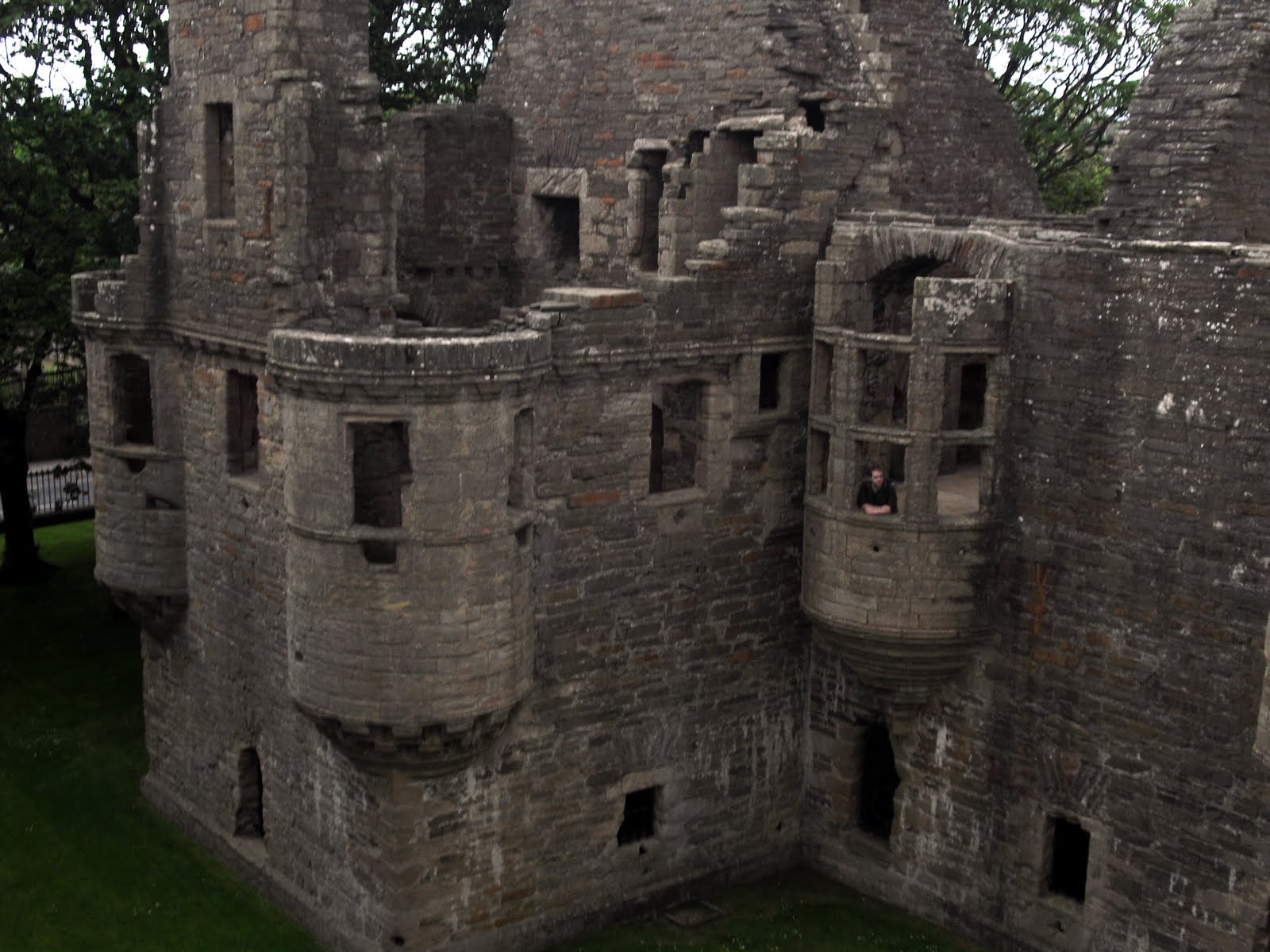
The Earl's Palace, Kirkwall (Orkney)

Most of what we know about Patrick Stewart comes from unreliable sources, and recent scholarship suggests he wasn't the huge jerk everyone makes him out to be. 

But whatever the size of Patrick's jerkitude, we do have him to thank for two of Scotland's most impressive Renaissance residences. The older of the two is Patrick's fortified palace in Kirkwall, Orkney.

The palace boasted both form and function: it included an enormous great hall, where the Earl and co. presumably got their respective grooves on . . .
(Historical reenactment.)

. . . and the place was built to withstand an attack from his next-door neighbor, the Bishop of Orkney.

Yes, the upstart Patrick set up shop right next door to the King's most powerful agent in the Northern Isles. You know the drill: keep your friends close and your enemies closer.


Patrick clearly bested the bishop as far as style was concerned: the Bishop's Palace is a tall, narrow, grim sort of a place, decidedly Medieval next to the Renaissance splendor of Patrick's new pad.
But apparently the bishop had Patrick beat in terms of function: the Earl's Palace was the site of Patrick's last stand, and had to be surrendered when opposing forces fired a cannon into one of those beautiful windows.

During the confusion, Nana may or may not have let her hair down in a failed effort to help Patrick escape.


Scalloway Castle, Shetland

Patrick's other house--in Scalloway, the ancient capital of Shetland--is another thing altogether. Where the Earl's Palace is an inviting house set in a small park in the middle of town, Scalloway Castle is a formidable tower house perched on a windswept spit of land. (Windswept even by Shetland standards!)

To access the castle, you have to sign out a key from a local hotel.
Nothing quite like letting yourself into a castle!

The inside couldn't be more different from the palace at Kirkwall: Scalloway Castle is pretty dim and grim. The living quarters would have been packed into the space below, with several levels of wooden floors and a roof that has been long since gone.
In fact, Patrick Stewart's two residences are a good summary of the differences between the two regions themselves: Orkney is by far the milder and the prettier of the two, whereas Shetland is far grimmer--though that has a way of being beautiful, too!

09 July 2010

The Shorkneys: Orkney and Shetland in the Viking Age, and St. Magnus

(Note: "Shorkney" is not a real word. We're just using it to write about our recent trip to Aberdeen, Orkney, and Shetland.)

The Viking Age


After about 800 AD, the Vikings began to settle in Orkney and Shetland, though it's unclear whether they conquered the Picts who were already there or simply drove them back to the Scottish mainland.

Shetland and Orkney--but especially Orkney--were extremely important during the Viking Age. First, they lay at the geographical center of Viking maritime culture, situated at the crossroads of the North Sea, the Norwegian Sea, and the Atlantic Ocean.
Second, Orkney included some of the most fertile land in the region, and so developed into one of the richest of the Norse provinces. In fact, as I mentioned in our post on Maes Howe, Orkney is home to the largest collection of Norse runes outside Scandinavia, and the Orkneyinga saga is one of the most important surviving pieces of Viking literature. The bits of these documents I've read are really quite funny: Maes Howe, for instance, is covered with silly boasts about the carvers being the best carvers of runes in the world, and at least one note that seems to compare another Viking's woman to a rabid dog.

Norse culture remains strong in Orkney and Shetland to this day. Though debt forced the king of Norway to give Orkney to the Scottish in 1468, and the Scottish came to dominate Shetland culturally and economically at about the same time, many people in the Northern Isles consider themselves to be about as much Scandinavian as Scottish. There is definitely something Scandinavian about the Shetland dialect, and the modern flags of Orkney (top) and Shetland (bottom) were specifically designed to reflect this Norse heritage.


Compare this to the Norwegian Flag, below, which features the same off-center cross and a similar color scheme.


St. Magnus Cathedral

St. Magnus Cathedral, in Kirkwall, Orkney, is the greatest surviving monument to the Viking Age in the Northern Isles.

The cathedral is dedicated to St. Magnus, a local Viking ruler who was martyred in the 12th century for refusing to participate in a bloody raid in Wales. The oldest parts of the cathedral were built shortly thereafter, in the Romanesque style. This style is characterized by round arches, like upside-down U's, and darker interiors than the later Gothic style (think York Minster or Notre Dame).

The Romanesque style is the same used in Durham Cathedral in England, as well as on Lindisfarne

You can see the round arches on either side of the photo below.
You'll notice that the window at the back, however, is a pointed or "vaulted" arch, in the later Gothic style. The ceiling is also vaulted, as are all the windows in the towers. This is because construction on the cathedral continued until the early 1900s. In fact, there's a sign on the building across the street with a diagram of the exterior of the cathedral showing when each section was built:
As it turns out, some of the most "Gothic" features are actually Victorian, part of the Gothic Revival at the end of the 19th century that gave us college campuses like Yale's.

St. Magnus also has some typically Norse features, such as a longboat on the altar . . .

. . . and interlocking arches, which some have argued are an intermediate stage between rounded arches and vaulted arches.
Bonus: There's a Norwegian consulate in Orkney! It must be one of the smallest towns in the world to host a foreign consulate.

06 July 2010

The Shorkneys: Delicious, Delicious Shorkneys

(Note: "Shorkney" is not a real word. We're just using it to write about our recent trip to Aberdeen, Orkney, and Shetland.)

The Orkney and Shetland Islands, I recall reading in the museums, cannot sustain themselves food-wise. Food has to be brought in on the same ferries that we took. While there, we went out of our way to try to get things that were local - not just for the hippy-dippy green food-mile value, but also for the fact that fresh things taste better, and also, heck, we went all the way to Orkney and Shetland. Let's not mess around eating French cheese.

Fortunately for your sake, we didn't photograph everything (between me and Justin, food often doesn't survive long enough to be photographed). But here are some culinary highlights.

First breakfast in Orkney: hotel B&B. I had amazing smoked salmon scrambled eggs (yes, the salmon was mixed into the eggs) and Justin had haddock covered in cheese and a poached egg:


Verdict. WHOA NELLY GOOD.

Due to its location on the North Sea and its jagged coastline, Scotland is prime fishing territory. Fish isn't, however, widely eaten here in Edinburgh. I've heard various reasons for it, the most common being that fish has traditionally been so lucrative to tin and sell south that the Scots never kept much back for themselves, but this might not be correct. For whatever reason, despite its prime location, Edinburgh is not a fishy part of Scotland. The Shorkneys, however, are. And God bless 'em for it.

Shetland is even more fish-eating than Orkney because of its lower percentage of arable land. Our Orkney guide articulated the difference as "Orcadians are farmers with fishing boats. Shetlanders are fishermen with farms."

Later in Kirkwall, Orkney: Helgi's

You will notice that Justin couldn't get me to stop eating long enough to take the shot.

Helgi's is delicious and reasonably priced, which our guide (who recommended it) said made it a welcome addition to Kirkwall's waterfront. If you go to the islands, I hear sometimes it can be hard to find a place to eat if you don't make a reservation ("booking" in UK-speak). So you may want to either call or drop into the restaurant earlier in the day or the day before to make sure you get seated.

We were kind of hankering for something green, so on the left, you have a salad with Orkney cheese and candied pear. Top is smoked haddock with beets and horseradish, and lower right is frighteningly delicious mackerel pate. We ordered all of these off the appetizer menu to allow us to try more stuff.

When we weren't quite full, we went for dessert:


Rhubarb and cream. Rhubarb is a hardy little plant that grows extremely well in Orkney, and cream is another famous Orcadian product (if it comes from a cow, Orkney's famous for it). I found the rhubarb completely delicious but thought the ratio was off - the cream got a bit rich because there wasn't enough rhubarb to balance it. On the whole, I would have liked this better on a pie crust so it would have a little more substance.

We had had some rhubarb and ginger jam at lunch earlier that day, which was delicious when spread on Orkney oatcakes (quite possibly my mother-in-law's favorite food in the world). I don't have any pictures; I'm just doing this as an excuse to say "rhubarb" some more. Rhubarb rhubarb rhubarb.

On to Shetland! (Rhubarb).

My friend Sarah, from Lerwick, suggested we get what she considers the world's best fish and chips at the Fort Cafe. Far be it from us to pass up what turned out to be the world's most fried dinner:

Fried haddock, french fries, and onion rings. Fresh vegetables are a bit slim in Shetland. If we lived in Shetland, I'm guessing we'd be the opposite of slim.

We had a fabulous dinner at our hotel but it was kind of a nice place so we didn't want to whip out the camera. We ordered from the appetizer menu again to get more variety. I think it ultimately included a bowl of smoked haddock/paprika chowder, pan fried scallops, and smoked salmon, with a cheese plate for dessert. The cheese was fabulous. The grapes looked a bit limp, but who can blame them? That's certainly how I felt after the ferry ride, and I only came from Kirkwall. Heaven knows where the grapes started out.

We timed our visit to Shetland to coincide with the Flavour of Shetland festival on the Lerwick Waterfront. This gave us the chance to try some local delicacies at the various booths. Here, Justin is eating a seafood gumbo:

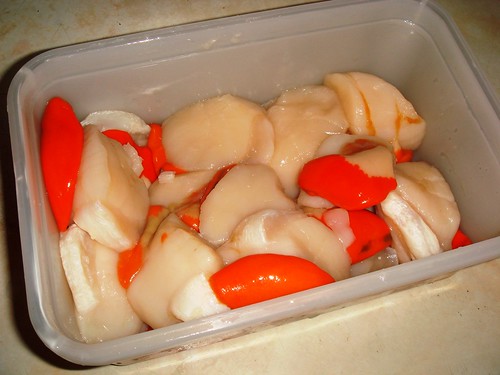
Really good. This was actually the first time I'd seen scallops with the bright orange part attached (see here for example). I assumed it was a foot, but I just looked it up for this blog post and discovered that it's actually roe, or eggs. It was lovely. Not quite as rich or as textured as lobster roe - it actually tasted a bit like the small sweet part of a crab claw. Highly recommended!

Also from the Flavours of Shetland pier: bannocks!

(That's the buttery bread things served here with stew which, if I remember correctly, was mutton and potato).

Bannocks are a type of biscuit - "biscuit" in the American sense, not the British sense of "cookie." They are quite delicious, having a doughy, baking soda flavor. You can find some recipes here on the Shetlopedia (of COURSE Shetland has its own pedia.) I think the best are beremeal. No, I don't know what beremeal is. I just know it comes out more brown, and richer and sweeter. Here I am watching the Shetland Cooking demonstration lady make bannocks:

The butter, from a local Shetland dairy, was incredibly sweet, creamy, and smooth. And guess what kind of jam is in that bowl! Yes, RHUBARB. RHUBARB RHUBARB RHUBARB.

Last but not least, our lunch on our final day in Shetland: lamb burgers (lamburgers?). Shetland and Orkney are both known for their lamb, as sheep do well on the windy hills. A fine end to our culinary tourism!

30 June 2010

The Shorkneys: Ancient Orkney (and Shetland)

(Note: "Shorkney" is not a real word. We're just using it to write about our recent trip to Aberdeen, Orkney, and Shetland.)

Orkney and Shetland entered the historical record much later than most of the rest of Europe, including the rest of the British Isles. The Romans wrote about Orkney as early as the first century AD. They probably also knew about Shetland, as the Orcadians of that time would have been in regular contact with Shetland--in clear weather, you can actually sail from Orkney to the Fair Isle and on to Shetland without ever losing sight of land.

But after the end of the Roman presence in Scotland in the third century AD, Orkney and Shetland fell out of history again. During this time, Orkney was part of the Pictish kingdom, a confederation of Celtic tribes that later merged with the better-known Gaels in the tenth century AD.

The Picts remain a mysterious people. They had no writing, at least that we can decipher--though some have argued that their carvings could have been a kind of primitive pictographic language. In Orkney and Shetland, they're known mostly for their brochs and the settlements that grew up around them.

A broch is a round drystone tower, usually built on the coastline as a lookout tower and fortification, or possibly as a stately home for local leaders. You can think of a broch as a kind of simple castle.

They're all over Scotland, but pretty much nowhere else--possibly because in other areas, such things were built of wood, but up until modern times wood had been scarce in Scotland for thousands of years. For the same reason, they're especially common in Orkney and Shetland. There's even a ruined broch next to a small loch by the Tesco in Lerwick, Shetland.

After our excursion to Skara Brae, we visited one of Orkney's most famous brochs, the Broch of Gurness.

This broch is special for a number of reasons. First, the tower itself is very well-preserved, to the point that it's still fairly easy to make out some of the interior rooms.


Second, the Broch of Gurness is surrounded by a broch village. Such villages have only been found in Orkney, and suggest either that the broch-building culture was centered in Orkney (so that its largest and most permanent settlements were there) or that other brochs were used more like forts or outposts than castles.

(Those were houses.)

One of the remarkable things about this broch village is how similar much of the architecture is to that found at Skara Brae, which is several thousand years older.

(Look familiar?)
(Cooler/cooking pot, anyone?)

A hands-on display at the Broch of Gurness visitor's center shows how basic technologies, such as hand mills for grain, had changed little since Neolithic times--probably because Orkney and Shetland lacked the natural resources needed for large-scale metalworking.


Third, the Broch of Gurness is important because archaeological finds at the site seem to confirm a Roman report about the King of the Orkneys submitting to the Emperor Claudius in 43 A.D.
Finally, the Broch of Gurness is also important because it, like many other earlier sites in Orkney and Shetland, were taken over by later Norse invaders. But that's a topic for another post!

Bonus! Ever wonder what an iron-age toilet based on stone-age technology might look like?


Then stop giggling and imagine a kind of chamber pot stashed beneath there.