

In our last post, we looked at the three great monuments of Neolithic Orkney: Maeshowe, the Standing Stones of Stenness, and the Ring of Brodgar. In this post, we'll look at Skara Brae, the fourth part of Orkney's UNESCO World Heritage Site.
Before we get into the (pre)history, though, we need a bit of backstory. You see, Skara Brae has been something of an obsession for Nana's family ever since her mother got her hands on a children's book about the site. (Yes, they're the kind of family that reads children's books about Neolithic villages.)
Nana's mom hates flying, but she always said if she were going to fly anywhere, it would be to Skara Brae. That right there is half the reason we went to the Shorkneys--the other half being the fact that a friend of ours here in Edinburgh hails from Shetland.
Now, I have to admit, I wasn't really sure Skara Brae would live up to that billing, and I was even less sure after we left Stenness. The Neolithic monuments of Orkney really got to me. It was just so amazing to think of people clinging to life in this far-flung corner of the world, unspeakable ages ago, devoting the work of several generations to these structures, which were science and religion and art, curiosity and hope and ambition, everything that makes us human really, all poured into these stones. I mean, how could Skara Brae compete with that?
But as it turned out, Skara Brae had its own kind of magic. Around the world, the vast majority of the structures that survive from that time (around 3000 B.C., just like the other Neolithic sites on Orkney) are ceremonial or monumental, and over time they've kind of become part of the landscape. But Skara Brae isn't: it's just a village, and a remarkably well-preserved one at that, which makes it so much easier to envision as a living place than a lot of other Neolithic sites.
Anyway--to the site!

Skara Brae is made up of ten houses clustered together at the edge of Skaill Bay, which opens onto the North Atlantic. The village may have been larger at one point: at the time it was inhabited, sea levels were lower, so the bay was a freshwater lake and the shoreline was farther away.
Today, as you can see from the photo below, the water comes almost right up to the ruins, making it quite a chore to preserve the site.

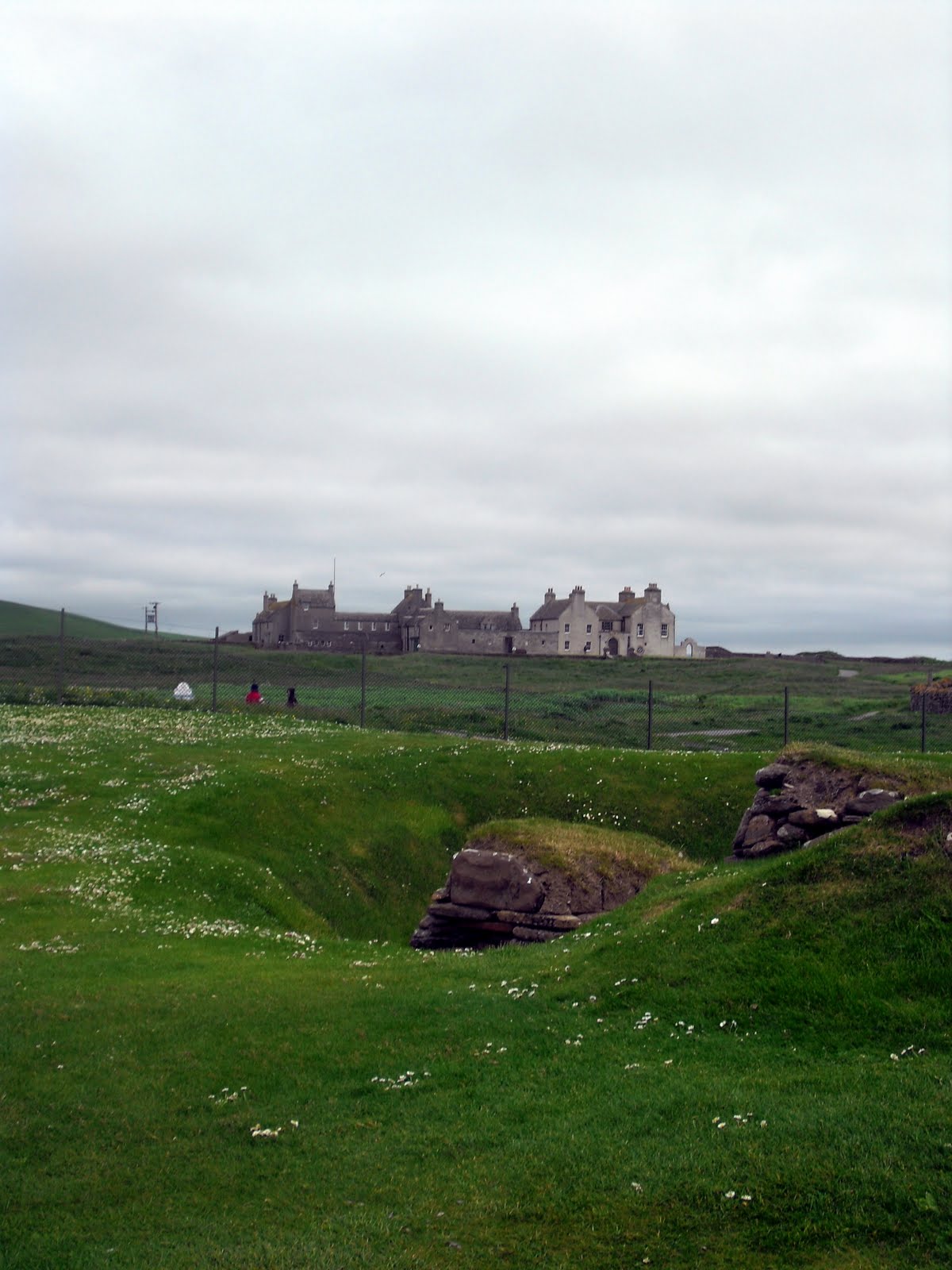
(It's a very big back yard.)
Each of the houses was a built of stone with earth spread on top. The earth was both for insulation and to hold the walls and ceilings together, kind of the same way the weight on the keystone of an arch keeps it from collapsing. Some of the oldest houses were dug down into the ground; others were built up above ground level or dug into man-made middens (ie, trash heaps).
The passages between and among the houses were also covered over, so the whole settlement was kind of like a system of man-made caves. It's not clear why they did this--possibly for more insulation.

(The path you see there would have been more like a tunnel.)
The houses themselves are very well preserved, and include some of the earliest examples of furniture ever found. Archeologists refer to the big shelves as "dressers" and the large compartments on the floor as "beds."

The smaller compartments may have been primitive coolers, or they may have been used to boil or steam food by filling them with water, dropping in a hot coal, and covering them up.
To give visitors a better idea of how the houses might have looked when they were in use, there's a walk-in model at the entrance to the site.


Beyond the houses themselves, Skara Brae has also been a treasure trove for other artifacts. Some of these artifacts also feature what looks like primitive writing--though this would be really strange, and such claims are very controversial.
In addition, a low road connects Skara Brae to the Ring of Brodgar, and there is also some evidence linking Skara Brae to certain Neolithic sites in Ireland.
In fact, cultural links between the Highlands and Islands of Scotland and the northern parts of Ireland have recurred throughout recorded history and on into the modern day, largely because for much of history it was so much easier to get around the British Isles by sea than by land. We'll see this again in a future post on how Orkney (and, to a lesser degree, Shetland) sat at the center of a medieval Norse empire that stretched from Scandinavia to Britain, Ireland, Iceland, and even North America.


