
If you've been following international news lately, you've probably heard something of the upcoming British general election. This one's a doozy for a variety of reasons, the foremost being that projected success by the centrist Liberal Democrats threatens to upset the longstanding two-party system.
A lot of the recent news, however, has been about the most recent TV debate has shifted the odds in favor of a Conservative (aka Tory) victory. Previously, bookmakers had put their money on a hung parliament.
Which begs the question: how many people actually bet on election outcomes in the UK? I haven't been able to find any hard data, but marketing campaigns by the big gambling chains suggest that they actually expect to make some money off those bets. As an American, this seems kind of odd to me: gambling is really not a huge part of American life, and is usually limited to the more conventional bets and games. But here in the UK, it's hard to walk more than a couple blocks on any commercial street without passing a betting parlor or two, and many of the bets advertised in the window are pretty exotic.
Stranger still is the use of published gambling odds in political advertising. Nana spotted a sign touting a Liberal Democrat candidate's odds as a come-on to potential voters: Labour, it seems, has been claiming that Lib Dem candidates can't win and any vote for a Lib Dem candidate is as good as a vote for a Tory (American third-party supporters will recognize this argument), so the Lib Dems have been very vocal when bookmakers have given them good odds of success.
An interesting bit of bandwagon propaganda . . . but could you imagine an American politician doing the same thing?
04 May 2010


03 May 2010
Scottish Accents
Due to its highly regional history and multitude of foreign linguistic influences, the UK has a mindboggling density of accents. When you think "Scottish accent," you probably think of Sir Sean Connery. But Connery's accent is only one of many Scottish accents - in the UK, accents are so regional that even regions like Scotland have their own regional accents.
Connery's accent (voted favorite UK accent in a 2005 BBC survey) is an Edinburgh accent. He grew up working-class, but his voice has posh-ified over the years. For a more current example of the Edinburgh accent Justin and I hear daily, try Jenny (at about 1 minute), who right now is on the BBC reality show Over the Rainbow competing to play Dorothy in the West End. The Edinburgh accent has a lot in common with the northern English accent, especially the letter "O," which sounds a lot like Yorkshire. My favorite thing about it is the way they say Edinburgh: "Eh-din-barrah."
Glasgow, however, has a different accent from Edinburgh. You might recognize it as the accent of Billy Boyd playing Pippin in Lord of the Rings. I have no technical linguistics-y terms for the difference, but it's rounder, less nasal, and the Os and Rs are different.
But even these are only two major regional variations. The Highlands and Islands (Western Scotland, including the Isle of Skye,) have an accent of their own (number 13), which to me sounds quite like an Irish accent. Maybe it's because both of those areas have a much longer history of Celtic languages. One of my coursemates has my favorite Scottish accent, the Shetland accent, which retains not only sounds but also some slangy vocabulary expressions from Norwegian. The BBC accent archive is being snippy with me because I don't have RealPlayer installed, but it's one of the few places I've found a Shetland accent.
And if you're really geeky, check out the George Mason speech accent archive: they've recorded hundreds of native and non-native speakers of English from all over the world. They only have two Scottish accents - Glasgow is here, Edinburgh is here - but the worldwide ones are a hoot. Check out a Yinzer here. You can also check out this Norwegian and learn why Justin and I are constantly mistaking English-fluent Scandinavians for people from some part of Britain we haven't been to yet.
27 April 2010
A Walk to Portobello
Portobello, aka "Edinburgh's Seashore," is a small sandy beach on the eastern edge of town, fronting the Firth of Forth. Originally a broad marsh called Figgate Muir, the area was renamed in the 18th century after Porto Bello, Panama, by a resident who served in the British campaign to capture that city in 1739. The small town spent most of the century as a haven for the whisky smugglers who ferried their contraband across from Fife.
And at the end of the century, the town picked up its obligatory Walter Scott connection: he was quartermaster of the Edinburgh Light Horse, who drilled on the Portobello sands. After being kicked by a horse during a drill, he retired to nearby Duddingston, where he finished his Lay of the Last Minstrel.
The area was developed as Victorian seaside town in the 19th century and, despite having gone through some rough times since, has reclaimed its status as a nice day out for Edinburgh folks. This post gives a little photo tour of the walk from our place in Newington to the Portobello shore, passing through some typically British neighborhoods of a sort most tourists don't really get to see.
The walk starts by skirting the southern flank of Arthur's Seat, pas Duddingston Loch.
 Duddingston Loch is the source of Figgate Burn, the creek which gave the Portobello area its original name.
The road winds into Duddingston itself, a small semi-rural enclave wedged between the southern slopes of Arthur's Seat and Duddingston Loch. In addition to its Walter Scott connection, Duddingston is home to two points of interest: a small medieval church . . .

. . . and the Sheep Heid Inn, Scotland's oldest pub.


The Sheep Heid dates from the 14th century, and has played host to James VI and I, Mary, Queen of Scots, Covenanters, Jacobites, and even Bonnie Prince Charlie en route to his victory at nearby Prestonpans. Today, it's a favorite stop for hikers down from Arthur's Seat. There's even a working skittles alley dating from 1870!
Here's a quick view back over Duddingston with Crow Hill, part of Arthur's Seat/Holyrood Park, in the background.

After Duddingston, the road widens into a postwar residential area. This is the closest thing you'll find in the UK to an American-style suburb.


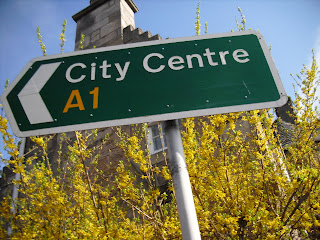
The road crosses the A1, Britain's longest official highway route, which connects Edinburgh and London.
Then more suburbs . . .

And a monstrous postwar-modern high school:

(Sorry for the blurring. It's a bit risky to take pictures of a school in the UK, especially one that's not a touristy spot like Heriot's.)
Around the bend from the high school, the road passes under an huge rail-road bridge and into Portobello proper.

Portobello works hard to tout its seasidey-ness, and about half the town is named after Brighton, southern England's most famous seaside resort.

The road into town from the west is dominated by St. James Church, a quirky bit of turn-of-the-19th-century architecture.

Generally, in the UK, the closer you get to the sea, the more Catholics. That's because so many of the 19th-century migrants to booming port towns came either from Ireland or the Highlands.
 The town itself is quaint, with one bustling stretch of high street and bunch of sleepy residential lanes.
The beach seems to come out of nowhere: no sights, sounds, or smells to tell you you're near.
 The view here looks east over the Firth of Forth. The distant triangular hill on the horizon is North Berwick Law. We visited North Berwick: check out our previous posts here and here.
The seaside itself is particularly British: a rundown promenade, overpriced chip shops, dingy arcades, and water too cold to swim in pretty much any time of the year.


Still, it's a pretty view, even on a hazy day like this one!
The excursion, like so many of my walks of late, was capped by a double-decker bus ride back to Newington. Here's another view of Crow Hill, this time over the suburban street with the modernist high school:

And at the end of the century, the town picked up its obligatory Walter Scott connection: he was quartermaster of the Edinburgh Light Horse, who drilled on the Portobello sands. After being kicked by a horse during a drill, he retired to nearby Duddingston, where he finished his Lay of the Last Minstrel.
The area was developed as Victorian seaside town in the 19th century and, despite having gone through some rough times since, has reclaimed its status as a nice day out for Edinburgh folks. This post gives a little photo tour of the walk from our place in Newington to the Portobello shore, passing through some typically British neighborhoods of a sort most tourists don't really get to see.
The walk starts by skirting the southern flank of Arthur's Seat, pas Duddingston Loch.

The road winds into Duddingston itself, a small semi-rural enclave wedged between the southern slopes of Arthur's Seat and Duddingston Loch. In addition to its Walter Scott connection, Duddingston is home to two points of interest: a small medieval church . . .

. . . and the Sheep Heid Inn, Scotland's oldest pub.

(The sign lies: on dreary days, dogs are welcome, and numerous, inside the pub as well!)

The Sheep Heid dates from the 14th century, and has played host to James VI and I, Mary, Queen of Scots, Covenanters, Jacobites, and even Bonnie Prince Charlie en route to his victory at nearby Prestonpans. Today, it's a favorite stop for hikers down from Arthur's Seat. There's even a working skittles alley dating from 1870!
Here's a quick view back over Duddingston with Crow Hill, part of Arthur's Seat/Holyrood Park, in the background.

After Duddingston, the road widens into a postwar residential area. This is the closest thing you'll find in the UK to an American-style suburb.


The road crosses the A1, Britain's longest official highway route, which connects Edinburgh and London.

Then more suburbs . . .

And a monstrous postwar-modern high school:

(Sorry for the blurring. It's a bit risky to take pictures of a school in the UK, especially one that's not a touristy spot like Heriot's.)
Around the bend from the high school, the road passes under an huge rail-road bridge and into Portobello proper.

Portobello works hard to tout its seasidey-ness, and about half the town is named after Brighton, southern England's most famous seaside resort.

The road into town from the west is dominated by St. James Church, a quirky bit of turn-of-the-19th-century architecture.

Generally, in the UK, the closer you get to the sea, the more Catholics. That's because so many of the 19th-century migrants to booming port towns came either from Ireland or the Highlands.

The beach seems to come out of nowhere: no sights, sounds, or smells to tell you you're near.

The seaside itself is particularly British: a rundown promenade, overpriced chip shops, dingy arcades, and water too cold to swim in pretty much any time of the year.


Still, it's a pretty view, even on a hazy day like this one!
The excursion, like so many of my walks of late, was capped by a double-decker bus ride back to Newington. Here's another view of Crow Hill, this time over the suburban street with the modernist high school:

26 April 2010
Where will the May flowers come from?
If, back in the broken boiler post, you took "Something we never saw coming" as the thing that breaks next, congratulations! The shower went out Friday. (It's genuinely eerie how everything that's broken thus far has done so on a weekend).
No more April showers for us!
No more April showers for us!
25 April 2010
Scone Palace: A Tragic Love Story
Yesterday, Justin and I took a day trip to Perth. (No, not THAT Perth, the OTHER Perth. The original one.) It doesn't quite make up for losing Athens, but it was the best we could do on short notice.
We visited historic Scone Palace (pronounced "Skoon Palace") and being colossal dorks, we will, of course, have extensive historical posts coming along shortly. However, after my recent dweebifesto on libraries, I thought it might behoove me to seek a less academic topic to give us all a break.
Thus, I present to you: Scone Palace: A Tragic Love Story.
Once upon a time, there was a girl in the gardens at Scone Palace.
 The gardens at Scone Palace are almost painfully upper class. First, it's the site of the Central Scotland International Horse Trials. Second they're full of oh-so-British fauna:
 And PEACOCKS:

 The girl's joy at the sight of the birds displeased a wicked enchanter with a suspiciously large wand.
 He placed a curse on the girl that made her believe she was a peacock. The girl obligingly set out to win the heart of a local hero:

But alas! He was more interested in other women:
 The girl's heart was broken.
 The magician found all of this very amusing.
 And so the girl was cursed to wander the gardens of Scone Palace forever, squawking obnoxiously and begging for snacks from tourists. Oh! The tragedy!

(Come on. This makes at least as much sense as Swan Lake. I mean, did you ever READ that story?)
Subscribe to:
Posts (Atom)
