Showing posts with label history. Show all posts

16 July 2010

The Shorkneys: Orkney and Shetland in the Renaissance


(Note: "Shorkney" is not a real word. We're just using it to write about our recent trip to Aberdeen, Orkney, and Shetland.)

 As I mentioned in our previous post, Shetland and Orkney both used to belong to the Norse. But when the King of Denmark (who was also the King of Norway) fell into debt, he was forced to forfeit the islands to Scotland in 1468 in lieu of a dowry for his daughter Margaret, who was sent over to marry King James III of Scotland. A year later, Christian I pawned Shetland to the Scots, too.

Under the Scots, the islands enjoyed a kind of golden age. They benefited from trade connections with Germany, the Netherlands, and Denmark, and the Scottish crown pretty much left them alone.

This wasn't always a good thing, however. Around 1600, Patrick Stewart, the 2nd Earl of Orkney, after brutalizing the local peasantry and spending himself into debt, actually went to war with the Sheriff of Shetland to back up his claim to ownership of the islands.

(What the 2nd Earl of Orkney might have looked like.)

For a while, things went pretty well for Patrick, but the escapade eventually landed him in prison in Edinburgh--and his son was hanged by the Sheriff of Shetland and a band of local malcontents. 

So Patrick Stewart: Petty tyrant? Mad genius? The greatest Star Trek captain of all time? You be the judge.

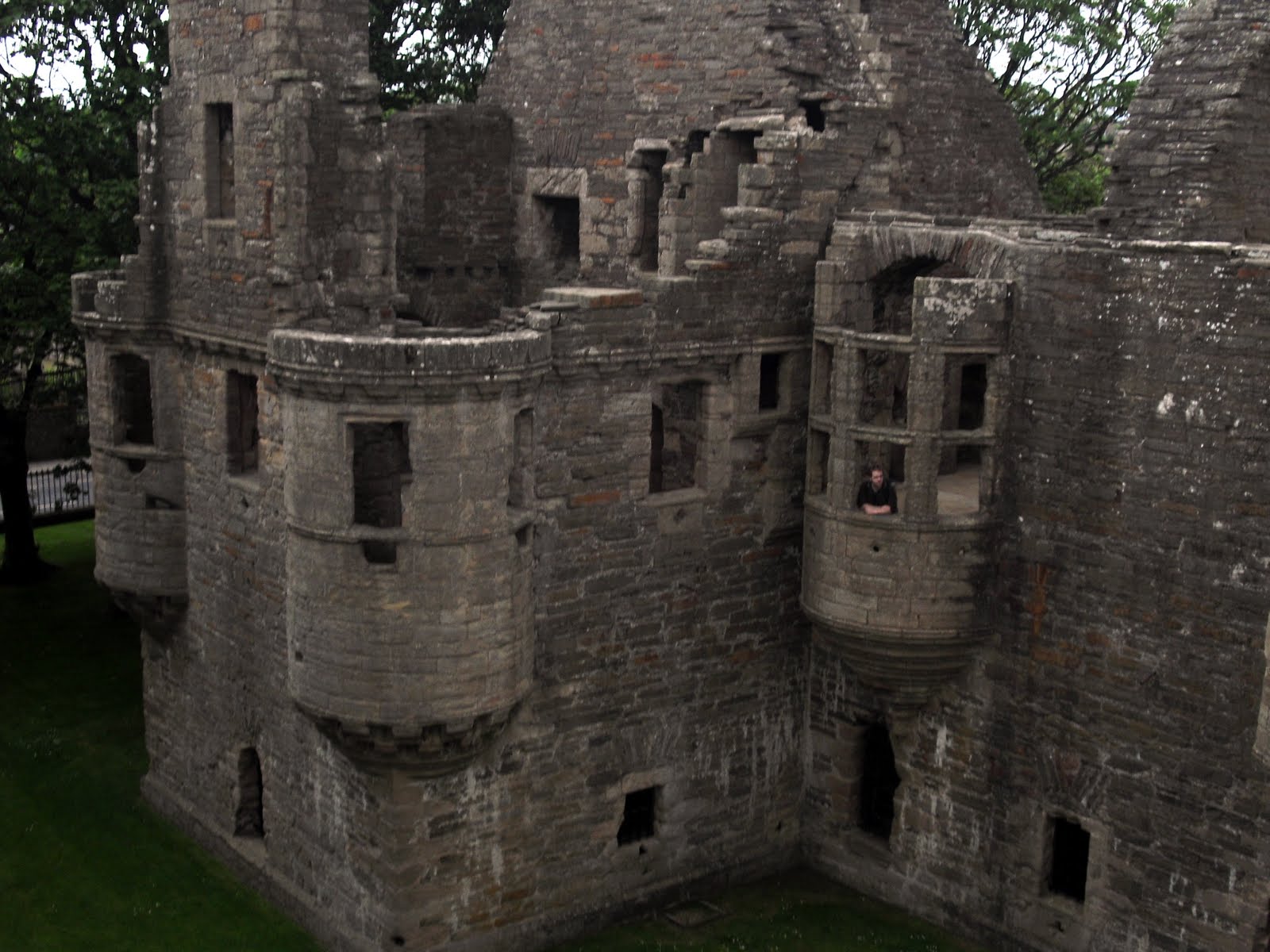
The Earl's Palace, Kirkwall (Orkney)

Most of what we know about Patrick Stewart comes from unreliable sources, and recent scholarship suggests he wasn't the huge jerk everyone makes him out to be. 

But whatever the size of Patrick's jerkitude, we do have him to thank for two of Scotland's most impressive Renaissance residences. The older of the two is Patrick's fortified palace in Kirkwall, Orkney.

The palace boasted both form and function: it included an enormous great hall, where the Earl and co. presumably got their respective grooves on . . .
(Historical reenactment.)

. . . and the place was built to withstand an attack from his next-door neighbor, the Bishop of Orkney.

Yes, the upstart Patrick set up shop right next door to the King's most powerful agent in the Northern Isles. You know the drill: keep your friends close and your enemies closer.


Patrick clearly bested the bishop as far as style was concerned: the Bishop's Palace is a tall, narrow, grim sort of a place, decidedly Medieval next to the Renaissance splendor of Patrick's new pad.
But apparently the bishop had Patrick beat in terms of function: the Earl's Palace was the site of Patrick's last stand, and had to be surrendered when opposing forces fired a cannon into one of those beautiful windows.

During the confusion, Nana may or may not have let her hair down in a failed effort to help Patrick escape.


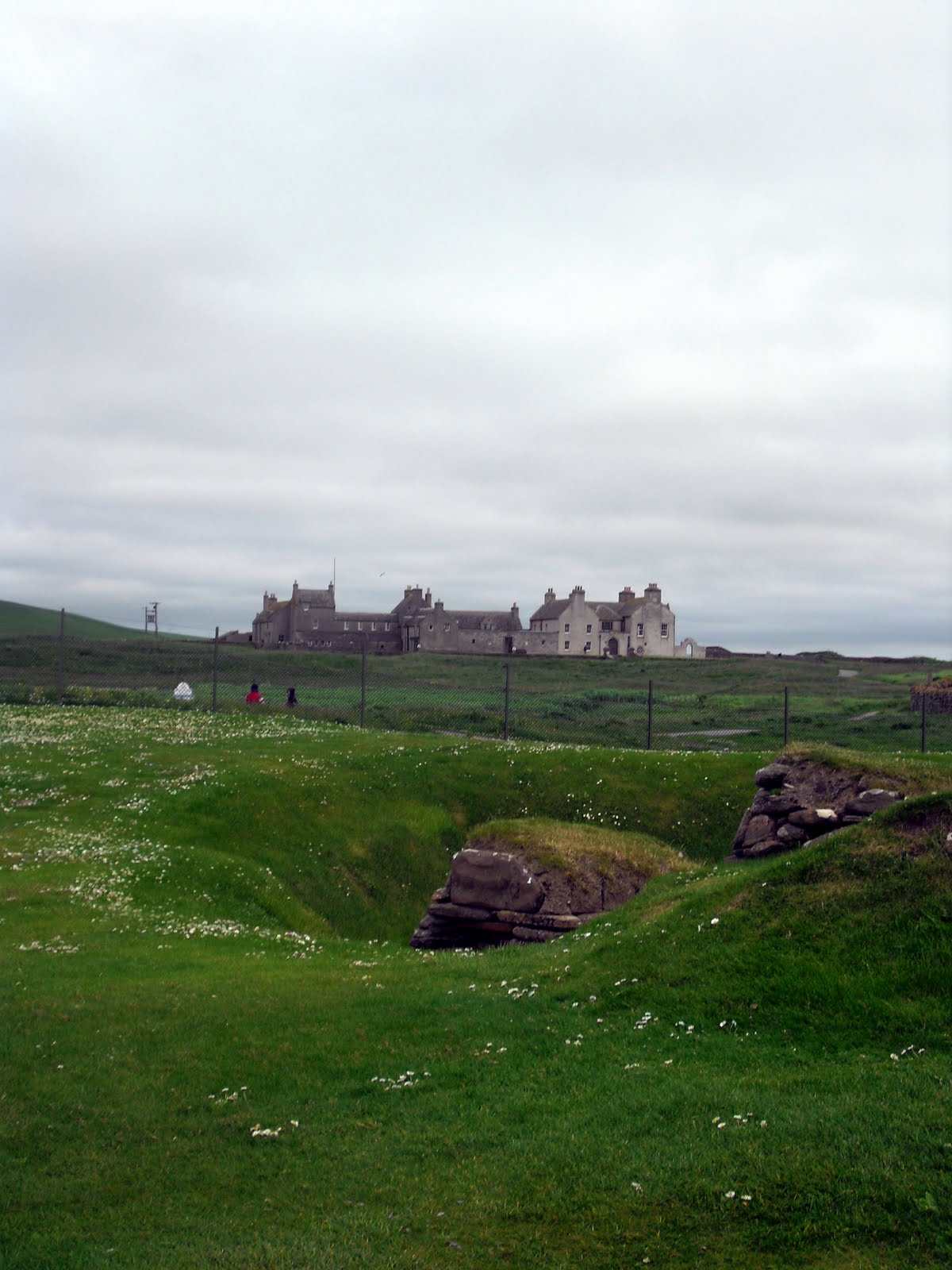
Scalloway Castle, Shetland

Patrick's other house--in Scalloway, the ancient capital of Shetland--is another thing altogether. Where the Earl's Palace is an inviting house set in a small park in the middle of town, Scalloway Castle is a formidable tower house perched on a windswept spit of land. (Windswept even by Shetland standards!)

To access the castle, you have to sign out a key from a local hotel.
Nothing quite like letting yourself into a castle!

The inside couldn't be more different from the palace at Kirkwall: Scalloway Castle is pretty dim and grim. The living quarters would have been packed into the space below, with several levels of wooden floors and a roof that has been long since gone.
In fact, Patrick Stewart's two residences are a good summary of the differences between the two regions themselves: Orkney is by far the milder and the prettier of the two, whereas Shetland is far grimmer--though that has a way of being beautiful, too!

09 July 2010

The Shorkneys: Orkney and Shetland in the Viking Age, and St. Magnus

(Note: "Shorkney" is not a real word. We're just using it to write about our recent trip to Aberdeen, Orkney, and Shetland.)

The Viking Age


After about 800 AD, the Vikings began to settle in Orkney and Shetland, though it's unclear whether they conquered the Picts who were already there or simply drove them back to the Scottish mainland.

Shetland and Orkney--but especially Orkney--were extremely important during the Viking Age. First, they lay at the geographical center of Viking maritime culture, situated at the crossroads of the North Sea, the Norwegian Sea, and the Atlantic Ocean.
Second, Orkney included some of the most fertile land in the region, and so developed into one of the richest of the Norse provinces. In fact, as I mentioned in our post on Maes Howe, Orkney is home to the largest collection of Norse runes outside Scandinavia, and the Orkneyinga saga is one of the most important surviving pieces of Viking literature. The bits of these documents I've read are really quite funny: Maes Howe, for instance, is covered with silly boasts about the carvers being the best carvers of runes in the world, and at least one note that seems to compare another Viking's woman to a rabid dog.

Norse culture remains strong in Orkney and Shetland to this day. Though debt forced the king of Norway to give Orkney to the Scottish in 1468, and the Scottish came to dominate Shetland culturally and economically at about the same time, many people in the Northern Isles consider themselves to be about as much Scandinavian as Scottish. There is definitely something Scandinavian about the Shetland dialect, and the modern flags of Orkney (top) and Shetland (bottom) were specifically designed to reflect this Norse heritage.


Compare this to the Norwegian Flag, below, which features the same off-center cross and a similar color scheme.


St. Magnus Cathedral

St. Magnus Cathedral, in Kirkwall, Orkney, is the greatest surviving monument to the Viking Age in the Northern Isles.

The cathedral is dedicated to St. Magnus, a local Viking ruler who was martyred in the 12th century for refusing to participate in a bloody raid in Wales. The oldest parts of the cathedral were built shortly thereafter, in the Romanesque style. This style is characterized by round arches, like upside-down U's, and darker interiors than the later Gothic style (think York Minster or Notre Dame).

The Romanesque style is the same used in Durham Cathedral in England, as well as on Lindisfarne. 

You can see the round arches on either side of the photo below.
You'll notice that the window at the back, however, is a pointed or "vaulted" arch, in the later Gothic style. The ceiling is also vaulted, as are all the windows in the towers. This is because construction on the cathedral continued until the early 1900s. In fact, there's a sign on the building across the street with a diagram of the exterior of the cathedral showing when each section was built:
As it turns out, some of the most "Gothic" features are actually Victorian, part of the Gothic Revival at the end of the 19th century that gave us college campuses like Yale's.

St. Magnus also has some typically Norse features, such as a longboat on the altar . . .

. . . and interlocking arches, which some have argued are an intermediate stage between rounded arches and vaulted arches.
Bonus: There's a Norwegian consulate in Orkney! It must be one of the smallest towns in the world to host a foreign consulate.

30 June 2010

The Shorkneys: Ancient Orkney (and Shetland)

(Note: "Shorkney" is not a real word. We're just using it to write about our recent trip to Aberdeen, Orkney, and Shetland.)

Orkney and Shetland entered the historical record much later than most of the rest of Europe, including the rest of the British Isles. The Romans wrote about Orkney as early as the first century AD. They probably also knew about Shetland, as the Orcadians of that time would have been in regular contact with Shetland--in clear weather, you can actually sail from Orkney to the Fair Isle and on to Shetland without ever losing sight of land.

But after the end of the Roman presence in Scotland in the third century AD, Orkney and Shetland fell out of history again. During this time, Orkney was part of the Pictish kingdom, a confederation of Celtic tribes that later merged with the better-known Gaels in the tenth century AD.

The Picts remain a mysterious people. They had no writing, at least that we can decipher--though some have argued that their carvings could have been a kind of primitive pictographic language. In Orkney and Shetland, they're known mostly for their brochs and the settlements that grew up around them.

A broch is a round drystone tower, usually built on the coastline as a lookout tower and fortification, or possibly as a stately home for local leaders. You can think of a broch as a kind of simple castle.

They're all over Scotland, but pretty much nowhere else--possibly because in other areas, such things were built of wood, but up until modern times wood had been scarce in Scotland for thousands of years. For the same reason, they're especially common in Orkney and Shetland. There's even a ruined broch next to a small loch by the Tesco in Lerwick, Shetland.

After our excursion to Skara Brae, we visited one of Orkney's most famous brochs, the Broch of Gurness.

This broch is special for a number of reasons. First, the tower itself is very well-preserved, to the point that it's still fairly easy to make out some of the interior rooms.


Second, the Broch of Gurness is surrounded by a broch village. Such villages have only been found in Orkney, and suggest either that the broch-building culture was centered in Orkney (so that its largest and most permanent settlements were there) or that other brochs were used more like forts or outposts than castles.

(Those were houses.)

One of the remarkable things about this broch village is how similar much of the architecture is to that found at Skara Brae, which is several thousand years older.

(Look familiar?)
(Cooler/cooking pot, anyone?)

A hands-on display at the Broch of Gurness visitor's center shows how basic technologies, such as hand mills for grain, had changed little since Neolithic times--probably because Orkney and Shetland lacked the natural resources needed for large-scale metalworking.


Third, the Broch of Gurness is important because archaeological finds at the site seem to confirm a Roman report about the King of the Orkneys submitting to the Emperor Claudius in 43 A.D.
Finally, the Broch of Gurness is also important because it, like many other earlier sites in Orkney and Shetland, were taken over by later Norse invaders. But that's a topic for another post!

Bonus! Ever wonder what an iron-age toilet based on stone-age technology might look like?


Then stop giggling and imagine a kind of chamber pot stashed beneath there.

29 June 2010

The Shorkneys: Neolithic Orkney, Part Two

(Note: "Shorkney" is not a real word. We're just using it to write about our recent trip to Aberdeen, Orkney, and Shetland.)


In our last post, we looked at the three great monuments of Neolithic Orkney: Maeshowe, the Standing Stones of Stenness, and the Ring of Brodgar. In this post, we'll look at Skara Brae, the fourth part of Orkney's UNESCO World Heritage Site.

Before we get into the (pre)history, though, we need a bit of backstory. You see, Skara Brae has been something of an obsession for Nana's family ever since her mother got her hands on a children's book about the site. (Yes, they're the kind of family that reads children's books about Neolithic villages.)

Nana's mom hates flying, but she always said if she were going to fly anywhere, it would be to Skara Brae. That right there is half the reason we went to the Shorkneys--the other half being the fact that a friend of ours here in Edinburgh hails from Shetland.

Now, I have to admit, I wasn't really sure Skara Brae would live up to that billing, and I was even less sure after we left Stenness. The Neolithic monuments of Orkney really got to me. It was just so amazing to think of people clinging to life in this far-flung corner of the world, unspeakable ages ago, devoting the work of several generations to these structures, which were science and religion and art, curiosity and hope and ambition, everything that makes us human really, all poured into these stones. I mean, how could Skara Brae compete with that?

But as it turned out, Skara Brae had its own kind of magic. Around the world, the vast majority of the structures that survive from that time (around 3000 B.C., just like the other Neolithic sites on Orkney) are ceremonial or monumental, and over time they've kind of become part of the landscape. But Skara Brae isn't: it's just a village, and a remarkably well-preserved one at that, which makes it so much easier to envision as a living place than a lot of other Neolithic sites.

Anyway--to the site!


Skara Brae is made up of ten houses clustered together at the edge of Skaill Bay, which opens onto the North Atlantic. The village may have been larger at one point: at the time it was inhabited, sea levels were lower, so the bay was a freshwater lake and the shoreline was farther away.

Today, as you can see from the photo below, the water comes almost right up to the ruins, making it quite a chore to preserve the site.
Sometime after it was abandoned (in about 2500 B.C., for unknown reasons), Skara Brae was covered over with a huge sand dune. The village lay hidden until 1850, when the proprietor of nearby Skaill House was walking his grounds the day after a huge storm and found this place basically in his back yard.
(It's a very big back yard.)

Each of the houses was a built of stone with earth spread on top. The earth was both for insulation and to hold the walls and ceilings together, kind of the same way the weight on the keystone of an arch keeps it from collapsing. Some of the oldest houses were dug down into the ground; others were built up above ground level or dug into man-made middens (ie, trash heaps).

The passages between and among the houses were also covered over, so the whole settlement was kind of like a system of man-made caves. It's not clear why they did this--possibly for more insulation.
(The path you see there would have been more like a tunnel.)

The houses themselves are very well preserved, and include some of the earliest examples of furniture ever found. Archeologists refer to the big shelves as "dressers" and the large compartments on the floor as "beds."
The smaller compartments may have been primitive coolers, or they may have been used to boil or steam food by filling them with water, dropping in a hot coal, and covering them up.
To give visitors a better idea of how the houses might have looked when they were in use, there's a walk-in model at the entrance to the site.
Beyond the houses themselves, Skara Brae has also been a treasure trove for other artifacts. Some of these artifacts also feature what looks like primitive writing--though this would be really strange, and such claims are very controversial.
In addition, a low road connects Skara Brae to the Ring of Brodgar, and there is also some evidence linking Skara Brae to certain Neolithic sites in Ireland.
In fact, cultural links between the Highlands and Islands of Scotland and the northern parts of Ireland have recurred throughout recorded history and on into the modern day, largely because for much of history it was so much easier to get around the British Isles by sea than by land. We'll see this again in a future post on how Orkney (and, to a lesser degree, Shetland) sat at the center of a medieval Norse empire that stretched from Scandinavia to Britain, Ireland, Iceland, and even North America.


27 June 2010

The Shorkneys: Neolithic Orkney, Part One

(Note: "Shorkney" is not a real word. We're just using it to write about our recent trip to Aberdeen, Orkney, and Shetland.)

As I mentioned in our previous post, Orkney is probably best known for its stone-age heritage, and rightfully so. The Heart of Neolithic Orkney is a UNESCO World Heritage Site comprising the four sites described below, each of which we visited in one action-packed day.


Of the four sites, three--Maeshowe, the Standing Stones of Stenness, and the Ring of Brodgar--are within sight of one another, arrayed around a land bridge between a salt-water inlet and a fresh-water loch at the center of a bowl-shaped valley. For complicated meteorological reasons, this area is one of the sunniest spots in all of Orkney, and on the day we visited it seemed to be suspended in a conspicuous bubble in the middle of a wall of sea mist.

(A major site at the Ness of Brodgar, between Stenness and the Ring of Brodgar, is still being excavated. Early reports suggest evidence of a "Neolithic cathedral"--similar, perhaps, to the Maltese megaliths we visited earlier this year.)

The fourth site, Skara Brae, is a short drive away from the other three. It will get its own short post sometime this week.

Maes Howe

Our first stop in Neolithic Orkney was Maeshowe, a burial chamber in the passage grave style. From the outside, the structure looks like a grassy hill plopped incongruously in the middle of a low plain.


Inside, the structure consists of a long, low passage (you have to double over to get in) leading to a large chamber, with smaller chambers branching off to three sides. (No photos inside, I'm afraid.)

Like many Neolithic structures, such as the much more famous Stonehenge in England, Maeshowe was apparently built to align with astronomical events. Here, on the winter solstice, the sun shines through the narrow entryway and illuminates the back wall of the chamber.

The current theory is that the chamber was used as an ossuary (a building for the ritual storage of bones), but the chamber was empty at the time of its "modern" discovery in 1861--emptied, possibly, by the Vikings, who also used Maeshowe as a shelter and, possibly, a burial chamber or treasure horde. In fact, in an upcoming post on Viking Orkney and Shetland, we'll look at Maeshowe again, as it's the largest repository of Old Norse runic inscriptions outside of Scandinavia.


Maeshowe dates from about 3000 BC--about 500 years older than Stonehenge.

Standing Stones of Stenness

The Standing Stones of Stenness, which also date to around 3000 BC, are the remnants of a stone circle standing roughly halfway between Maeshowe and the Ring of Brodgar. Some archaeologists speculate that the circle was a temple to the moon, while the Ring of Brodgar across the way was a temple to the sun.

The surviving stones are very tall, as you can see below, and the complete ring must have been an awesome sight back in the day!

Stenness has been used as a ritual site into modern times, though usually associated with Norse mythology rather than with any direct Neolithic connection. Local couples used to use the Odin Stone (now toppled) to pledge their engagements. Couples would hold hands through the hole in the stone and speak a traditional oath.


The Standing Stones of Stenness even bear the mark of Sir Walter Scott, whose shadow one just cannot escape in this country. Scott visited the site in 1814 and decided to incorporate it into one of his novels, The Pirate, which is the fictionalized tale of a local boy, John Gow, who sailed off into the wide world and made good by going bad.

In The Pirate, Scott (who was never afraid to pull out all the stops) used Stenness as the setting for an attempted human sacrifice, adding an entirely fictional sacrificial altar to the scene. Later visitors to the site, presumably unwilling to live in a universe in which Walter Scott could be proven wrong, duly erected an altar of their own.


It was only much later that some pranksters knocked the false altar down.

The Ring of Brodgar

The Ring of Brodgar is an enormous henge and stone circle a few hundred meters on the other side of Stenness from Maeshowe. To get there, you pass the Watchstone of Stenness and cross a narrow man-made causeway dating to Neolithic times.


In fact, it was this causeway that caused the water on the right to turn fresh while the water on the left remained salty. This phenomenon likely attracted even more settlers to the area, as from one spot you can fish for both saltwater and freshwater fish.

The stones of Brodgar themselves aren't all that big (much smaller than either Stenness or Stonehenge) . . .

. . . it's the scale of the site as a whole that's impressive. When you're inside it almost doesn't feel like a circle.

The fact that Historic Scotland, who administer all of the Heart of Neolithic Orkney sites, has left the center of the ring overgrown with an impassable thicket of heather only adds to the desolate beauty of the place.

Like Stenness, the Ring of Brodgar has also become a focal point for more recent traditions. Local legend has it that if you walk around the circle counterclockwise three times, you will have a baby within the following year.

(Don't get too excited--we walked around clockwise, and then only once!)

Bonus Question: Where did the other stones go?


Both circles (Stenness and Brodgar) are currently incomplete, but we know they used to be complete because archaeologists have found the holes where the other stones used to be. Some of the stones were broken by the weather. When lightning strikes on the open plain around Stenness and Brogdar, it's likely to hit one of the stones. That's what got the stone below--though this one stayed standing.

Some stones, after they were broken or fell over, were carried away to be used in other building projects to save the builder from having to quarry new stone. Such stones were especially in demand because wood is so scarce in Orkney, making stone the preferred building material since times immemorial.

In fact, that's one of the wonders of these sites: you'd expect them to be even more incomplete. But it seems that later cultures largely respected (possibly, feared) these Neolithic monuments and tried to leave them be.