Showing posts with label UNESCO. Show all posts

29 June 2010

The Shorkneys: Neolithic Orkney, Part Two

(Note: "Shorkney" is not a real word. We're just using it to write about our recent trip to Aberdeen, Orkney, and Shetland.)


In our last post, we looked at the three great monuments of Neolithic Orkney: Maeshowe, the Standing Stones of Stenness, and the Ring of Brodgar. In this post, we'll look at Skara Brae, the fourth part of Orkney's UNESCO World Heritage Site.

Before we get into the (pre)history, though, we need a bit of backstory. You see, Skara Brae has been something of an obsession for Nana's family ever since her mother got her hands on a children's book about the site. (Yes, they're the kind of family that reads children's books about Neolithic villages.)

Nana's mom hates flying, but she always said if she were going to fly anywhere, it would be to Skara Brae. That right there is half the reason we went to the Shorkneys--the other half being the fact that a friend of ours here in Edinburgh hails from Shetland.

Now, I have to admit, I wasn't really sure Skara Brae would live up to that billing, and I was even less sure after we left Stenness. The Neolithic monuments of Orkney really got to me. It was just so amazing to think of people clinging to life in this far-flung corner of the world, unspeakable ages ago, devoting the work of several generations to these structures, which were science and religion and art, curiosity and hope and ambition, everything that makes us human really, all poured into these stones. I mean, how could Skara Brae compete with that?

But as it turned out, Skara Brae had its own kind of magic. Around the world, the vast majority of the structures that survive from that time (around 3000 B.C., just like the other Neolithic sites on Orkney) are ceremonial or monumental, and over time they've kind of become part of the landscape. But Skara Brae isn't: it's just a village, and a remarkably well-preserved one at that, which makes it so much easier to envision as a living place than a lot of other Neolithic sites.

Anyway--to the site!


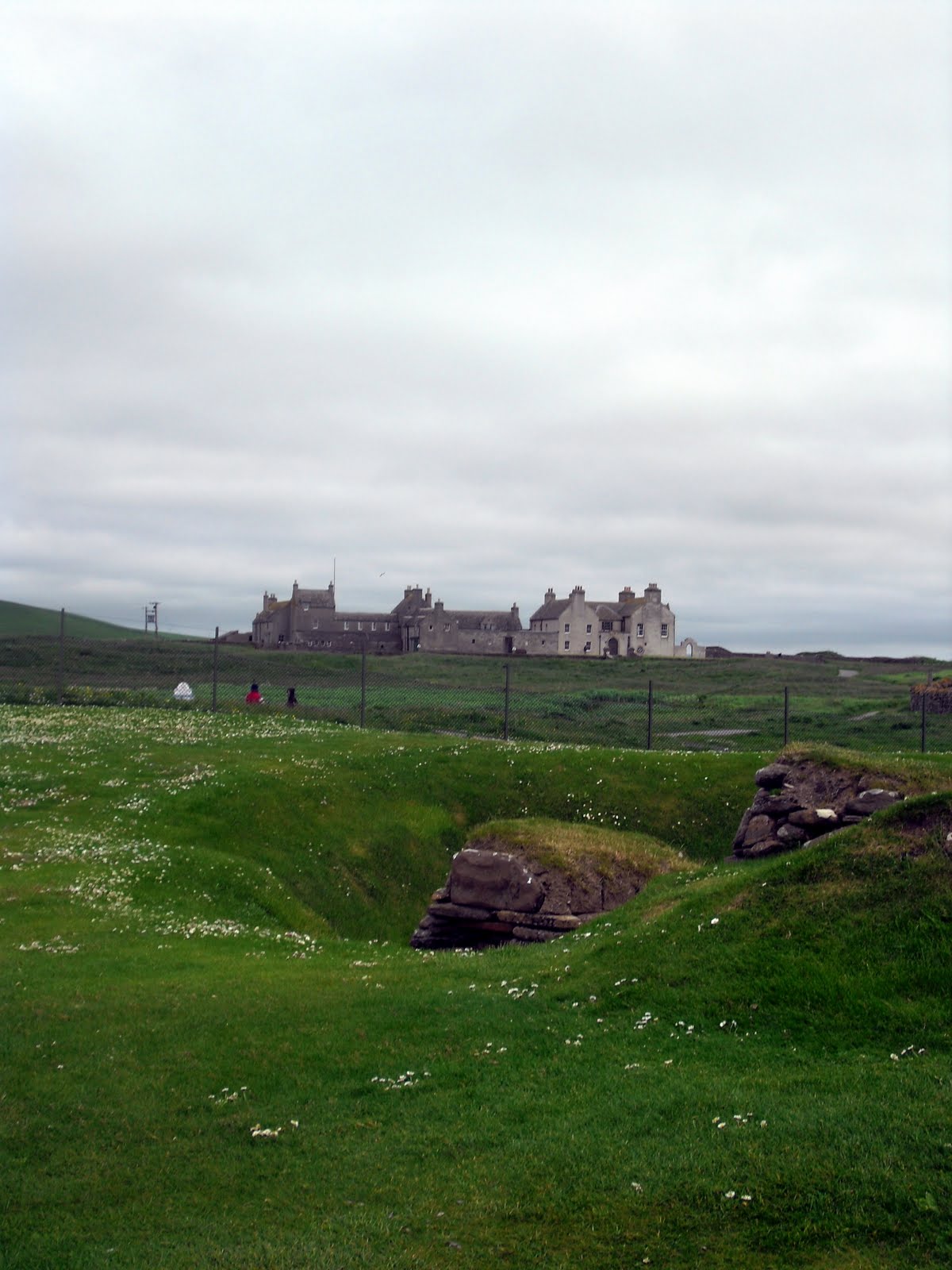
Skara Brae is made up of ten houses clustered together at the edge of Skaill Bay, which opens onto the North Atlantic. The village may have been larger at one point: at the time it was inhabited, sea levels were lower, so the bay was a freshwater lake and the shoreline was farther away.

Today, as you can see from the photo below, the water comes almost right up to the ruins, making it quite a chore to preserve the site.
Sometime after it was abandoned (in about 2500 B.C., for unknown reasons), Skara Brae was covered over with a huge sand dune. The village lay hidden until 1850, when the proprietor of nearby Skaill House was walking his grounds the day after a huge storm and found this place basically in his back yard.
(It's a very big back yard.)

Each of the houses was a built of stone with earth spread on top. The earth was both for insulation and to hold the walls and ceilings together, kind of the same way the weight on the keystone of an arch keeps it from collapsing. Some of the oldest houses were dug down into the ground; others were built up above ground level or dug into man-made middens (ie, trash heaps).

The passages between and among the houses were also covered over, so the whole settlement was kind of like a system of man-made caves. It's not clear why they did this--possibly for more insulation.
(The path you see there would have been more like a tunnel.)

The houses themselves are very well preserved, and include some of the earliest examples of furniture ever found. Archeologists refer to the big shelves as "dressers" and the large compartments on the floor as "beds."
The smaller compartments may have been primitive coolers, or they may have been used to boil or steam food by filling them with water, dropping in a hot coal, and covering them up.
To give visitors a better idea of how the houses might have looked when they were in use, there's a walk-in model at the entrance to the site.
Beyond the houses themselves, Skara Brae has also been a treasure trove for other artifacts. Some of these artifacts also feature what looks like primitive writing--though this would be really strange, and such claims are very controversial.
In addition, a low road connects Skara Brae to the Ring of Brodgar, and there is also some evidence linking Skara Brae to certain Neolithic sites in Ireland.
In fact, cultural links between the Highlands and Islands of Scotland and the northern parts of Ireland have recurred throughout recorded history and on into the modern day, largely because for much of history it was so much easier to get around the British Isles by sea than by land. We'll see this again in a future post on how Orkney (and, to a lesser degree, Shetland) sat at the center of a medieval Norse empire that stretched from Scandinavia to Britain, Ireland, Iceland, and even North America.


27 June 2010

The Shorkneys: Neolithic Orkney, Part One

(Note: "Shorkney" is not a real word. We're just using it to write about our recent trip to Aberdeen, Orkney, and Shetland.)

As I mentioned in our previous post, Orkney is probably best known for its stone-age heritage, and rightfully so. The Heart of Neolithic Orkney is a UNESCO World Heritage Site comprising the four sites described below, each of which we visited in one action-packed day.


Of the four sites, three--Maeshowe, the Standing Stones of Stenness, and the Ring of Brodgar--are within sight of one another, arrayed around a land bridge between a salt-water inlet and a fresh-water loch at the center of a bowl-shaped valley. For complicated meteorological reasons, this area is one of the sunniest spots in all of Orkney, and on the day we visited it seemed to be suspended in a conspicuous bubble in the middle of a wall of sea mist.

(A major site at the Ness of Brodgar, between Stenness and the Ring of Brodgar, is still being excavated. Early reports suggest evidence of a "Neolithic cathedral"--similar, perhaps, to the Maltese megaliths we visited earlier this year.)

The fourth site, Skara Brae, is a short drive away from the other three. It will get its own short post sometime this week.

Maes Howe

Our first stop in Neolithic Orkney was Maeshowe, a burial chamber in the passage grave style. From the outside, the structure looks like a grassy hill plopped incongruously in the middle of a low plain.


Inside, the structure consists of a long, low passage (you have to double over to get in) leading to a large chamber, with smaller chambers branching off to three sides. (No photos inside, I'm afraid.)

Like many Neolithic structures, such as the much more famous Stonehenge in England, Maeshowe was apparently built to align with astronomical events. Here, on the winter solstice, the sun shines through the narrow entryway and illuminates the back wall of the chamber.

The current theory is that the chamber was used as an ossuary (a building for the ritual storage of bones), but the chamber was empty at the time of its "modern" discovery in 1861--emptied, possibly, by the Vikings, who also used Maeshowe as a shelter and, possibly, a burial chamber or treasure horde. In fact, in an upcoming post on Viking Orkney and Shetland, we'll look at Maeshowe again, as it's the largest repository of Old Norse runic inscriptions outside of Scandinavia.


Maeshowe dates from about 3000 BC--about 500 years older than Stonehenge.

Standing Stones of Stenness

The Standing Stones of Stenness, which also date to around 3000 BC, are the remnants of a stone circle standing roughly halfway between Maeshowe and the Ring of Brodgar. Some archaeologists speculate that the circle was a temple to the moon, while the Ring of Brodgar across the way was a temple to the sun.

The surviving stones are very tall, as you can see below, and the complete ring must have been an awesome sight back in the day!

Stenness has been used as a ritual site into modern times, though usually associated with Norse mythology rather than with any direct Neolithic connection. Local couples used to use the Odin Stone (now toppled) to pledge their engagements. Couples would hold hands through the hole in the stone and speak a traditional oath.


The Standing Stones of Stenness even bear the mark of Sir Walter Scott, whose shadow one just cannot escape in this country. Scott visited the site in 1814 and decided to incorporate it into one of his novels, The Pirate, which is the fictionalized tale of a local boy, John Gow, who sailed off into the wide world and made good by going bad.

In The Pirate, Scott (who was never afraid to pull out all the stops) used Stenness as the setting for an attempted human sacrifice, adding an entirely fictional sacrificial altar to the scene. Later visitors to the site, presumably unwilling to live in a universe in which Walter Scott could be proven wrong, duly erected an altar of their own.


It was only much later that some pranksters knocked the false altar down.

The Ring of Brodgar

The Ring of Brodgar is an enormous henge and stone circle a few hundred meters on the other side of Stenness from Maeshowe. To get there, you pass the Watchstone of Stenness and cross a narrow man-made causeway dating to Neolithic times.


In fact, it was this causeway that caused the water on the right to turn fresh while the water on the left remained salty. This phenomenon likely attracted even more settlers to the area, as from one spot you can fish for both saltwater and freshwater fish.

The stones of Brodgar themselves aren't all that big (much smaller than either Stenness or Stonehenge) . . .

. . . it's the scale of the site as a whole that's impressive. When you're inside it almost doesn't feel like a circle.

The fact that Historic Scotland, who administer all of the Heart of Neolithic Orkney sites, has left the center of the ring overgrown with an impassable thicket of heather only adds to the desolate beauty of the place.

Like Stenness, the Ring of Brodgar has also become a focal point for more recent traditions. Local legend has it that if you walk around the circle counterclockwise three times, you will have a baby within the following year.

(Don't get too excited--we walked around clockwise, and then only once!)

Bonus Question: Where did the other stones go?


Both circles (Stenness and Brodgar) are currently incomplete, but we know they used to be complete because archaeologists have found the holes where the other stones used to be. Some of the stones were broken by the weather. When lightning strikes on the open plain around Stenness and Brogdar, it's likely to hit one of the stones. That's what got the stone below--though this one stayed standing.

Some stones, after they were broken or fell over, were carried away to be used in other building projects to save the builder from having to quarry new stone. Such stones were especially in demand because wood is so scarce in Orkney, making stone the preferred building material since times immemorial.

In fact, that's one of the wonders of these sites: you'd expect them to be even more incomplete. But it seems that later cultures largely respected (possibly, feared) these Neolithic monuments and tried to leave them be.


12 June 2010

London Museums, Part II: Greenwich

Greenwich has a special place in my heart because of the time during 12th grade astronomy when my friend Najja noticed our textbook had accidentally spelled it "Greewinch," which then became our running joke for the rest of the year. But whatever way you spell it, Greenwich is a treat.

The National Maritime Museum has the actual uniform Nelson was wearing when shot on the quarterdeck during the Battle of Trafalgar. The bloodstains still on the uniform are dramatic, but what I found most touching were the non-regulation stockings, which sailors often wore in place of uniform goods because they were warmer. I like the idea of Britains' greatest naval hero dealing with such a plebeian concern as cold toes.

We also offer a hearty salute to the Discover Greenwich Museum, where Justin accidentally left the camera among a set of foam blocks but fortunately recovered it in time for the rest of the tour. The museum has interesting and accessible information about the town as well as the pre-naval history of the site (including Anne Boleyn's palace).

Greenwich Naval Hospital wasn't really a hospital in the modern sense - that is, a place for treating patients. It was more of a nursing home for sailors too old or injured to serve at sea anymore. It housed sailors between 1694 and the 1860s, when it was closed down, and was funded both by charitable donations and mandatory deductions from the paychecks of active sailors.

Wearing replica pensioner's garb:

Relaxing in a replica Hospital room:

(For those of you who don't think Justin is in enough pictures, that's his shadow on the bunk. That's kind of like a picture of Justin. Maybe?)

But Greenwich, England, did not earn its UNESCO World Heritage status as "Maritime Greenwich" for its museums, even though they're quite nice and spectacularly free of charge. It received it because, among other reasons,
Criterion (ii): Maritime Greenwich bears witness to European architecture at an important stage of its evolution, exemplified by the work of great architects such as Inigo Jones and Christopher Wren who, inspired by developments on the continent of Europe, each shaped the architectural development of subsequent generations...
And
Criterion (vi): Greenwich is associated with outstanding architectural and artistic achievements as well as with scientific endeavour of the highest quality through the development of navigation and astronomy at the Royal Observatory, leading to the establishment of the Greenwich Meridian and Greenwich Mean Time as world standards.
Let's tackle Criterion (ii) first.

Christopher Wren, perhaps best known as the architect of St. Paul's Cathedral, planned the Old Royal Naval College with a dedication to symmetry and under the strict mandate not to interfere with the view of the Queen's House (by Inigo Jones) to the river. In fact, the foam blocks where Justin mistakenly left the camera were there so you could experiment with the way you would have responded, architecturally, to Wren's challenge. I'm fairly sure, however, that Wren had no foam blocks and had to do it the hard way.

Wren ultimately devised this remarkable panorama, seen more clearly in the Wikipedia article here:

The Queen's House is so tiny that Justin and my combined big domes (did you know there wasn't a ski helmet in all of Japan that fit Justin's head?) completely erase it from the picture. Here it is when I relocate to the right:

I always thought my college dining halls were fairly attractive. Compare them to the Painted Hall, they're downright dull.

Those clever things in the middle are mirror tables. Having schlepped all over the world getting neck cramps trying to look at all those ceilings people spent squillions of dollars on, I heartily say, forget the architecture. These tables constitute Greenwich's greatest service to mankind. Here's the ceiling, as photographed in the table.

The man who painted them, James Thornhill, was paid by the yard and eventually knighted for his work. Who wants to volunteer to tell Michelangelo?

The Chapel of St. Peter and St. Paul is a lovely English Baroque space for both worship and music. We were lucky enough to visit during a rehearsal by some students from the Trinity College of Music, also located in Greenwich. The acoustics were lovely, as was the chance to sit down for five minutes. Traveling ain't always as glamorous as it looks.


And now on to Criterion (iv), the one about the Royal Naval Observatory. Before coming here, I knew Greenwich more as the home of Greenwich Mean Time than the home of anything else. (It also is the home of Meantime Beer, which is outstanding).

Dava Sobel's (fun and readable) book Longitude outlines Britain's search for a practical way to determine, quite literally, where on earth you were. For a pretty long time, it's been easy to calculate your distance north or south by using the stars. Unfortunately, calculating your distance east and west was not so easy. A mistake might mean that rather than being safely at sea, you were in fact six inches from crashing into Tierra del Fuego.

The solution, devised by clockmaker John Harrison in the mid-1700s, was a clock that worked at sea. If you had three pieces of information - time at your home port (as shown by the clock), the longitude of your home port (previously calculated), and the time where you were (set by noon, the sun's peak in the sky), you could then calculate your longitude mathematically. This represented a colossal breakthrough in navigation, and also in the art of crafting timepieces, since Harrison couldn't use wood (warped by humidity) or weights (rolling at sea) in his oceangoing clocks. The series of clocks he made are on display at the observatory.

The Greenwich Time Ball on top of the observatory here is raised and dropped at 1 PM every day, a holdover from Ye Olden Times as a way to signal the time to ships in the harbor (harbour!), therefore allowing them to set their clocks for navigation. Edinburgh has its own equivalent - a ball on Calton Hill and Edinburgh Castle's One o'Clock Gun, presumably because Edinburgh weather does not always allow you to see the hilltop.

I was so excited at this prospect that I dragged Justin out of the museum in the rain to take a picture.

He was not impressed, hence the lack of climactic "after shot" of the dropped ball. Alas.

The Greenwich Meridian, also known as the Prime Meridian, is the officially designated line for 0 degrees longitude, which means it divides the Western and Eastern Hemispheres. It's like the Equator but going up and down instead of around the middle. Unlike the Equator, it's completely arbitrary. The Equator is astronomically and geologically defined: it marks the location on the earth's surface when the sun is directly overhead at noon on the solstices. It also marks the spot at which every day, regardless of the season, has the same amount of daylight (on Earth, roughly 12 hours. I, by contrast, live in Scotland, where last winter's December solstice featured a soul-destroying six hours and fifty-seven minutes of daylight and the upcoming June solstice will probably be around seventeen hours and thirty-five minutes long. As I write this post, it's 10:21 PM and light enough to read a book outside. It's a weird place, Scotland.)

Anyway, unlike the equator, which has to be where it is, the Prime Meridian could be located anywhere. Beijing. Hoboken. Your house. There was, in fact, a time when other Prime Meridians were in use, most particularly the Paris Meridian by the rival French. But in 1884, when it was put to a vote, Greenwich won by a vote of 22-1. (France abstained). This is primarily due to the fact that just as Britain's navy dominated the seas, Britain's mapmakers dominated cartography, and most people had just become used to calculating their longitude from a British map using a Greenwich meridian. America's choice of Greenwich as the starting point for its domestic time zones, and therefore also for its maps, probably didn't hurt, either. Oh, France - have we always been a thorn in your side? I hope the answer is yes.

So here you have them, folks, a large part of the reason I went to Greenwich and definitely all of the reason I schlepped up the huge hill to the observatory: Photos at the Prime Meridian!

Justin doesn't know which way to go:

Our marriage looks good from the outside, but really, we're not even in the same hemisphere these days:

My brother-in-law Ryan always mocks my family for being slow, but I bet he's never run across two hemispheres in two seconds!

(Ryan is probably saying, "How did that take you two whole seconds?" I blame our camera's busted autofocus, which means it takes us way too long to take pictures.)

So that's Greewinch. Hope you enjoyed!

13 February 2010

City of Literature: Edinburgh books

If I asked you what world city was the first title holder of the UNESCO designation "City of Literature," I'm not sure Edinburgh would leap to your mind. It certainly didn't leap to mine; my first guess was London. But Edinburgh it is: the City of Literature.

I will cede the floor to Justin on discussing the role of Edinburgh in English-language publishing (hint: massive) because heck, it's what he studies. Instead, I'll write a bit here about some books with Edinburgh connections, and make some suggestions in case you want to pick up a book that gives you a peek into our current hometown.

Harry Potter Series, by J.K. Rowling

If you've been paying attention, you already knew this! Edinburgh has served as the place of writing and also as the inspiration for many aspects of this series, including locations and character names. I won't bother to describe the series, but the Edinburgh connection was new to me when I moved here.

Who might enjoy: Everybody in the world, apparently

The Inspector Rebus series, by Ian Rankin

Inspector Rebus is an Edinburgh police detective. The series began in the late '80s - I got a chuckle at the scene in the first book where Rebus mentions his pride and joy, a Japanese-manufactured tape deck - but is still going strong. I've only read the first book, Knots and Crosses, but I ran into many Edinburgh locations that make up my daily life. I particularly enjoyed the scene where Rebus walks from his apartment in Marchmont (where there's a particularly nice beer shop Justin and I frequent) across the Meadows (how we get to campus) through Greyfriars Kirkyard (where we went with Meghan to see the Tom Riddle tombstone) and into the Central Public Library (where I currently have five books checked out). I think they've moved the children's section since the book was published, but the reference room is exactly as described. I should know - I researched there last December!

Who might enjoy: Rebus is not a procedural mystery, which is to say, you are not given clues to piece the mystery together. It's a crime novel much more in the thriller vein. The first one was violent (about child kidnapping and murder) but very little violence happened "on screen." You didn't get passages narrated by the crazy killer, which I always hate. I can't vouch for later ones. It's more for fans of Tom Clancy or James Patterson than Agatha Christie.

The Sunday Philosophy Club Series, by Alexander McCall Smith


Another Edinburgh mystery series. (Edinburgh and crime just seem to go together... maybe it's the weather, which can politely be termed "atmospheric.") Actually, word on the street has it that Rowling, McCall Smith, and Rankin are pals, and sometimes get together for a cup of tea.

To be honest, I read this book two years ago, before Edinburgh was even a glint in my eye, so I don't remember much of the plot or the Edinburgh connections. McCall Smith is better known for his No. 1 Ladies' Detective Agency Series, which I prefer for its more lighthearted and chatty style. But if you like five-page philosophical digressions on Camus with your mystery novels (and I know you're out there), this may be a series you'd enjoy.

Who Might Enjoy: Seriously? I just answered that.

The Lymond Chronicles, by Dorothy Dunnett


Neither a mystery nor a book set in the present! The Lymond Chronicles is a massive six-volume series about a Scottish aristocrat named Francis Lymond, who becomes a key player in the political intrigue among England, Scotland, Ireland, France, and others during the early childhood of Mary, Queen of Scots. Lymond is brilliant, and watching him juggle plots and schemes while knowing he'll always somehow pull it out is great fun. His compatriots, sadly, do not always make it out with him (expect to lose many supporting characters along the way) and it's often Lymond's fault. Unlike superman James Bond heroes, he makes mistakes and changes and learns. I am about to start book 4, and I have been assured at a romance book forum I frequent that a thoroughly satisfying romance will conclude this series.

Edinburgh appears many times in the series. This website lists them all, but don't go there if you haven't read the series yet, as it's full of spoilers. One highlight for me was watching Lymond race up the Grassmarket to make it in time for a climactic sword fight in St. Giles' Cathedral. It doesn't look the same, as the building was Catholic during the 1550s but is Church of Scotland today, but if I moved some screens and altars around in my mind, I could get a very good idea of the setting. Bonus for Justin and me - a scene set at Tantallon Castle and a large chunk of the third book in Malta!

Who might enjoy: Anybody who likes a large but tightly plotted historical epic with a great lead character. Diana Gabaldon fans, fans of the Scarlet Pimpernel (with a higher tolerance for secondary character suffering), Scottish history buffs (many real people are part of the story).

Kidnapped, by Robert Louis Stevenson

I expect shrieks of outrage from Justin when this post goes up. He did a paper on Kidnapped last term in which he discussed the publication history of the book, including its selection as the first book for the "One Book, One Edinburgh" project. This was a City of Literature campaign to get everyone in Edinburgh to read the same book, and it included sponsoring a graphic novel adaptation of Kidnapped by the legendary Alan Grant and Cam Kennedy. Justin got a very good grade on this paper, but he gets an Incomplete for this blog post.

Kidnapped is set in the 18th century (1700s, for people like me who can never do that math correctly). It's an adventure tale originally published for young men (oh, Justin must be twitching now!). Most of the narrative takes place outside of Edinburgh, with a few exceptions near the beginning and end. It features the famous description of Auld Reekie "smoking like a kiln." I also liked the description of Grassmarket (the same one featured in Lymond):

"The huge height of the buildings, running up to ten and fifteen storeys, the narrow arched entries that continually vomited passengers, the wares of the merchants in their windows, the hubbub and endless stir, the foul smells and the fine clothes, and a hundred other particulars too small to mention.."

Writing in the early 19oos about the mid 1700s and applicable to the early 2000s (see image here). Nicely done, Bobby Louie Stevie.

Who might enjoy: According to Justin, everybody. Good for all ages. Stevenson's writing is clear and vivid and does not read at all as if it's one hundred years old (he's sort of like Orwell that way).

The Highland Countess, by Marion Chesney

You're not getting through this list without at least one romance novel. The Scottish/Highland subgenre in romance is colossal. Edinburgh is Lowland Scotland, so many romances don't actually include scenes here, but The Highland Countess does. I'm including it as a representative for every tartan-covered novel with a claymore-wielding Laird and semi-Scots expressions like "dinna fash" and "wee lassie."

Actually, I love Marion Chesney. My mother probably hates her, because of the time I misplaced a library book called Deborah Goes to Dover and we had to pay for it. I still have no idea where that book is. The Highland Countess is a similar plot to many Regency London-set novels, but it provides a fun alternative setting. I remember the scene in which the heroine, moving into her husband's apartment on the Royal Mile, reflects on some of the same human smells mentioned above by Stevenson. Edinburgh, historically, has not been a salubrious place.

Who might enjoy: Anybody who enjoys clever, short stories with happy endings. This is a very mild romance as far as... well, "romance" goes. Safe for most readers.

Honorable Mentions: The Strange Case of Dr. Jekyll and Mr. Hyde by Robert Louis Stevenson, and the Sherlock Holmes mysteries, by Arthur Conan Doyle.

(They're public domain, so if you click on the above links, you can read them online for free!)

Honorable Mentions because these books are ostensibly set in London, but any reader paying attention can pick out Edinburgh elements. Jekyll and Hyde, in particular, has foggy closes and passageways that could only be Old Town Edinburgh. Like Kidnapped, it was chosen as a City of Literature book (of Doyle's work, they chose The Lost World instead of a Holmes novel. It's good but not Edinburgh-y).

Additionally, both feature characters based on real Edinburghers. The double-life of Jekyll and Hyde likely drew on the story of Deacon Brodie, an upstanding Edinburgh cabinetmaker and councilman who just happened to moonlight as a burglar to pay for his gambling habit. Arthur Conan Doyle based Sherlock Holmes on one of his professors at the University of Edinburgh, a man named Joseph Bell. The professor was noted for his keen sense of observation and his process of logical deduction. Today, the university has a Joseph Bell Centre for Forensic Statistics and Legal Reasoning (very fitting, one must say.)

Who would enjoy: Jekyll and Hyde is a very readable and highly engaging classic. Don't assume you won't enjoy the book just because you know the plot twist. As for Sherlock Holmes - well, don't judge the books by the movie. Anybody could enjoy these. They are not violent and move quite quickly. Personally, I love the short mysteries, which come in collections. The longer mysteries tend to be padded out in the last two-thirds by an extensive victim/perpetrator backstory - of the longer ones, I can only recommend Hound of the Baskervilles without reservation.

And that's not even all the books with Edinburgh connections out there. If you run into another one, leave a comment on the page here and tell me what you thought of it!

15 January 2010

History from the Bottom Up, Part 2: Things To See In Malta When You're Dead

This is Part 2 in a series about Maltese history, as told via the conceit of an archaeological excavation - from the bottom layer up.

The Hypogeum


(Visitor's note: Hypogeum tickets must be booked in advance. Our guidebook suggests at least two weeks; the guide on site said even earlier in the busy season. We certainly only got ours on a week's notice because it was January. You can purchase and print tickets online.)

The Hal Saflieni Hypogeum (select it from the "sites" dropdown menu) provides another excellent excuse for a teacher to sneak in a vocabulary exercise. While sitting in the lobby, Justin and I realized we didn't actually know what a hypogeum was. We puzzled it out and came up with "hypo" from "hypodermic needle," which we figured must mean "under-skin needle," and added "geo," meaning "earth," and "-um" as a Greek suffix, a la gymnasium, meaning a place or room. Therefore, a hypogeum must be an underground room.

And guess what? That's precisely what it is. A very, very, very, very old underground room. This room was dug out below ground at roughly the same time the megaliths were being erected on the surface, which is to say, c. 3500 or 3000 BC, five thousand years ago. As I mentioned before, I struggle to contextualize such remote history. It's about the same time as the settlement at Skara Brae, in the Orkneys (on our list to visit when it gets warmer) and is about 1000-1500 years older than when most Biblical historians estimate Abraham to have lived.

Unlike the megaliths, the Hypogeum makes you feel every one of those years.

The Hypogeum is special for many reasons. First, it's tremendously well-preserved for its age. It was discovered in the late 19th century by accident, when houses were built on the site. Justin suggests that the late rise in Maltese population density may be a critical factor in the discovery of so many important Neolithic sites here. China is so large that things get lost. In Egypt, where the space has been continuously densely inhabited, ancient places are often destroyed or looted. Malta, however, is small enough that things are likely to be found, and did not get dense enough to require intensive building-over until the 19th century. The bad news is that much was lost in the first few years, before the site came to the attention of archaeologists and the house-building was stopped. It also was damaged by its own popularity - as with Lascaux Caves, carbon dioxide from visitors' breath damaged the wall paintings. It's since been restored with the help of UNESCO.

But what IS it? That's the second reason it's special. It was a burial site, yes, but there are other ancient burial sites in the world. What's odd about the Hypogeum is that it was both a burial site and place of worship - a graveyard inside a church (something we'll see more of in Malta later on). Today, the bodies are in many places: lost during the early excavations, moved to research facilities, and (to my surprise) in some cases left undisturbed. According to my guide, that's been done so that if future technology surpasses modern technology, they'll still have something original left to inspect. Interesting and farsighted - I haven't heard of it being done anywhere else.

Visitors aren't allowed to take pictures inside the Hypogeum, but even if we could, they wouldn't convey the feeling you get from visiting the site. I think Justin and I were fortunate to visit on a day that the audio guides were experiencing technical difficulties, because that meant we were shown around by a live curator for the site, a man named Joseph. I don't think any prerecorded guide could have done what Joseph did. He made you feel the site so strongly that you expected to come around the corner and see it in use. This room in particular - the main chamber - he really brought to life. If you take a look at that image, I'll try to capture some of the ideas he shared about it. Don't blame him for any leaps of imagination here; any melodramatic interpretation of the space's use is purely my own.

Although the room was likely used for religious purposes, it might help you envision it to compare it to a theatre. The picture is taken from where the tour group stands, and presumably where the ordinary people would have stood in prehistoric times. Your eye is immediately drawn to the doorway in the upper right. Through a clever trick of perspective, this doorway appears human-sized, but is in fact much shorter. A priest entering through this space would have to duck. An impressive way to make an entrance.

The doorways to the left help create that illusion, as they are about large enough for a person to lie down in. You assume the other doorway is the same. Some archaeologists suggest that the spaces were dreaming chambers for priests to receive visions - maybe with a bit of artificial help in the form of hallucinatory libations or smoke. The walls would have been painted in red ochre, with the carved uprights and crosspieces left white.

It is very difficult to argue that the room was not intended for audience and performers of some sort, which in turn indicates a complex and hierarchical society with a division of labor. Someone would also have had the task of standing here, a carved wall niche which, when spoken into, projects the speaker's voice throughout the entire underground complex.

So there you are, a prehistoric inhabitant of sunny island Malta. You come underground for some sort of ceremony, and the temperature shifts: if it's summer, you're strangely cold; if winter, unnaturally hot. The light changes to flickering fire and lamps on red and white walls that maybe even remind you of muscle and bone, like you're inside the body of the earth. Men doze fitfully in carved niches, perhaps crying out at their strange dreams. The air is filled with humidity and smoke. Chanting or singing reverberates through the space, but you can't see the source of the sound.
Could the ground itself be talking to you? Suddenly, a colossal figure, twice the size of a human body, erupts out of a doorway, flinging its arms wide and shouting at you.

I think I would have passed out.


Roman Catacombs

Jumping forward in time from prehistory to the classical period, we come to the Roman layer of Maltese history. Malta was ruled by the Phoenicians via the city of Carthage (of "Carthago delenda est"/Hannibal and the elephants fame) but the conquered by the Romans, who called it Melita. A catacomb is the modern term for an underground cemetery, which I believe the Romans would have called a necropolis ("city of the dead").

Malta has two, quite proximate to each other, in the city of Rabat, which is just outside the old capital of Mdina. This makes sense, because "Rabat" is a Semitic language family word for "suburb" (or settlement outside the city walls) and Roman law stipulated that all necropoli must be situated outside the city walls, presumably for hygiene reasons. The first one we visited was called St. Paul's, and is part of the Heritage Malta pass package.


It comes with a good audio guide, although the locations underground are not always easy to find. Makes you understand why in Roman times, you needed professional catacomb diggers ("fosserii") to help you find your ancestors.

At St. Paul's, you can see a number of interesting carved stone resting places:

- arcosolium - looks a bit like a carved window seat with a canopied arch, except of course no window
- canopied tombs - hard to find a picture; looks just like a canopy bed
- small "loculi" - carved niches in walls; here mostly for babies and children
- floor graves

And more. St. Agatha's is similar, but better preserved - and also not included with the Heritage Malta pass, so it will set you back an additional admission fee. A highlight of St. Agatha's is the surviving Roman fresco, and the more recent church, which I'll get to in a later post on Christian Malta. In the high season, with larger groups, you can't go into the fresco room anymore, but once again Justin and I lucked out by being the only two people on the tour.

Our guide was researcher working on the catacombs and gave us some interesting information about it. The Maltese catacombs, for instance, contain both Christians and Jews, and are not segregated by religion. His current research is into the fact that according to tomb carvings, Jews of the period significantly outlived Christians: Christians made it to their 40s, whereas Jews lived into their 70s. The theory is that this relates to Jewish hygiene laws, which mandated frequent ablutions (washing), such as upon every return from the marketplace.

We also talked about carved agape tables (the one shown in the link is St. Paul's), where Romans would come down into the catacombs for a funeral banquet. People would recline around this table to eat and drink. Take a look at the carved circular part of the table. See the break in the lip? That's for swiping spilled food into a bucket, for which there was a carved niche ready. Eventually, this practice was banned by the Catholic church. St. Paul's's ('s's's) audio guide said discreetly that this was due to immoral practices. The St. Agatha's guide was more direct. Let's just say that by the early middle ages, they were throwing some toga-optional toga parties in the catacombs.

A final comment on the Hypogeum and catacombs: in keeping with archaeological logic (archaologic?) and the theme of my posts, you would probably assume that the lowermost layers of these places would be the oldest. In fact, that's backwards. Think about it: you're digging down from the surface. You can't carve the bottom part without having gone through the top part first. Therefore, underground facilities are a weird and interesting exception to the law of lower=older. In the catacombs and hypogea of the world, the further down you go, the more recent the space is.

Whew! That was a beast of a post. And now my work here is done... time to head toward the light...


12 January 2010

History From the Bottom Up, Part 1: Maltese Megaliths

First, an addendum: You may be wondering how a couple of broke graduate students afforded a holiday trip like this. The answer is that we didn't. My grandfather Bibo, one of the Official Grandpas of The Educated Burgher, gave us a tremendously generous Christmas cheque and told us to do something valuable to us with it. We asked him if he'd like to be the sponsor of a vacation we otherwise wouldn't have taken, and he said absolutely.

So as they say in Muppet Christmas Carol: to Mr. Batchelder, the Founder of the Feast!

And now back to the history.

Human settlement on Malta dates back at least 5,500 years. This means, as it often does in Europe, that history is stacked on top of history. Justin and I will report back on our Maltese explorations, starting with what remains underground and working our way up.

Maltese Megaliths

Until now, the oldest place I've visited in person was the burial site of the Terracotta Army in Xi'an, China. Dating back to ~210 B.C., it predates the Roman Coliseum by nearly 300 years, although those of you who have been to Greece will be less impressed (the Parthenon, for instance, is 200 years older), as will visitors to the Pyramids, which are a whopping 2,300 years older - the oldest was built around 2600 BC.

Well, Those Of You Who Have Been To Greece And Egypt, hold on to your chairs and prepare to be impressed. The oldest construct on Malta dates back to about 3600 B.C. That's right - as far away from the Pyramids as we are from Charlemagne. I'm referring to the Megaliths of Malta, a collective UNESCO World Heritage Site. These stone temples were built all over the islands, evidently for religious purposes. The oldest temple complex, Ggantija, is often considered the oldest freestanding stone structure in the world.

Not only are they old, they're also huge. Time for a vocabulary teaching moment! Ggantija, as you may have guessed, does incorporate the word "Giant": it means "Giant's Tower. (Although Maltese is a Semitic language, and primarily Arabic in grammatical structure, much of the vocabulary comes from Italian. It's comparable to English's classification as a Germanic language in spite of the bulk of the vocabulary coming from Latin through French). The Maltese temple builders departed inexplicably some time around 2500 BC, and later inhabitants of the island often attributed their temple ruins to a race of giants. Bonus vocabulary: the word "megalith," from the Greek "mega" (large) and "lithos" (stone) also refers to the size of the structures.


A close-up of the sign shows the distinctive trefoil shape of Maltese temples:

and Justin poses inside next to a well-preserved altar:

Ggantija is located on Gozo, one of the three Maltese islands (Malta, Gozo, and Comino). Nobody lives on Comino except hotel staff in the tourist season. The other currently excavated megaliths are located on Malta.

Hagar Qim:


Mnajdra:


The last picture suggests a solution to the question of how the temples were roofed. Wood has been scarce on Malta since prehistoric times. The temple builders solved this problem by corbelling. This means that when you build a wall, you make each stone layer slightly longer than the one it sat on, gradually closing the walls in. It ends up looking like you're inside a beehive. (I learned about corbels as a kid from What It Feels Like To Be A Building, which for my money is the world's best children's book on architectural engineering.)

What's that you say? I promised to start underground? Hey, they used to be underground. It's not my fault archaeologists got there first. In fact, the excavation in the 19th century of most of these temples has been a bad thing. Scientific methodology at the time was not as stringent, and the exposure of the sites to wind and rain has caused them to deteriorate more in the last hundred years than in the thousands they spend below ground. The scaffolding you saw above on the Ggantija Temples is part of the preservation effort. Hagar Qim and Mnajdra have been placed under tents:


Another means of preservation is removing the original stones and replacing them with replicas. The decorated stones shown here are replicas placed at the Tarxien Temples site. The originals have been moved to the National Museum of Archaeology for preservation.

Carved animal stone; perhaps an altar:

Spiral patterns, a popular design motif in Malta's prehistoric art:

And remains of one of Malta's famous "fat lady" figures, which suggest a mother goddess or fertility cult to modern scholars.

But if you won't buy my excuse-making that previously underground sites qualify as underground, then how about this: tune in next time for the Hal Saflieni Hypogeum!

Overall personal reaction to the temples? Well, it is definitely cool to see them, but for me, it was a struggle to see them as they were, and to remember that they had been buildings. Tarxien in particular is a messy pile of stones. I think kids or students would have serious difficulty envisioning the original form and connecting to the colossal engineering achievement that they represented at the time. After seeing two or three, the temples started to blur with each other, and I was annoyed that the sites themselves did not make a clear distinction between original and replica stonework. The entrance fees also feel steep, possibly due to the expense of preservation, unless you do what we did and get the Heritage Malta pass (it gives you one access each to all their sites, including museums, and is a much better bargain if you are planning on seeing at least four or five sites).

Eddie Izzard has a comedy routine in which he proposes that mass murder is simply too much for the human mind to comprehend. The gist is that one murder earns you the death penalty, serial killing perhaps puts you in an asylum, but twelve million murders leaves you thinking, "Well done! You must get up very early in the morning!" (It is, admittedly, a particularly dark comedy routine). I think I had a similar feeling with the temples. Five thousand five hundred years is simply not an age that I can make meaningful in my mind. This is my problem, though, and not a problem with the sites. As a UNESCO junkie, I'm definitely glad I went, but my experience at the Hypogeum was much stronger.