
BoingBoing has posted a story about a high-school senior in Alberta who was denied permission to wear a kilt to his graduation. The student is of Scottish extraction, and his principal appears to be completely unaware of or sympathetic to a style of formal dress common not only in Scotland but across Canada, too.
Then again, kilts are kind of hilarious.


22 May 2010
Scottish scenery
Justin and I usually focus on pictures of us. Partly, that's because we have grandmas reading this blog, and they're more interested in pictures of us than in pictures of scenery that you could find anywhere. It's also because I'm vain. In any case, I realized we had some nice scenic shots we hadn't shared. Photo credit on just about all of these goes to Justin. I'm pretty sure we haven't posted any of these before, but my apologies if it's a repeat.
Sunrise from Arthur's Seat, Edinburgh, October 2009
 Snow on Holyrood Park, Edinburgh, January 2010
 View from Mar's Wark, Stirling, December 2009
 Mountains, possibly Trossachs, from Stirling, December 2009
 Sunset from Stirling Castle, December 2009

 Meadows park, Edinburgh, May 2010.

Highlands, September '09


 Rainbow over Inverness, September '09

Edinburgh Old Town from Calton Hill, August '09

Sunset on Arthur's Seat, May 2010 (Photo credit - friend Anne Marie)
 Hope you enjoyed!
Perth/Scone Palace, Part the Last (Probably): Baby, I'm A-Mazed
The gardens at Scone Palace are so remarkable that you can actually pay a separate admission just to go to the grounds. I'm not sure why you would, though, since nobody seems to be paying any attention to the back gate. (But you didn't hear it from me).
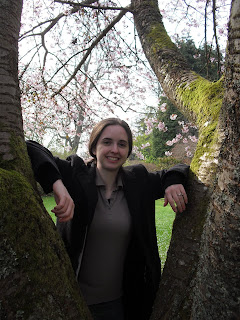
There is, as shown in a previous post, a lovely set of cherry trees:
 For the deceased visitor, I recommend the graveyard and the family chapel. Most of the stones I remember seeing in the graveyard were nineteenth century, but that may be selection bias: the most recent stones are the easiest to read, and therefore the ones I saw and remembered. That doesn't mean that there weren't older ones there.


The chapel sits on Boot Hill, supposedly the ancient Scottish coronation site (where the Stone of Scone used to sit. It is perhaps apocryphally composed of soil brought from around Scotland in the boots of the local lords, because convention dictated that they swear loyalty standing on their own land. The lords would then empty out their boots on the site. I'm skeptical. Back when I was a tour guide, this is exactly the sort of thing we used to make up. It's too good to be true.
 There is a Pinetum.

What is a Pinetum, you ask? According to the web site:

 This fir may be the long-lost cousin of the similarly-appendaged Tembusu Tree from the Singapore Botanical Gardens.
There is a maze shaped like a star.

 Justin says: Left or right?

Nana says: Gaaaah!
 Ultimately, victory was ours:

There is, as shown in a previous post, a lovely set of cherry trees:

 For the deceased visitor, I recommend the graveyard and the family chapel. Most of the stones I remember seeing in the graveyard were nineteenth century, but that may be selection bias: the most recent stones are the easiest to read, and therefore the ones I saw and remembered. That doesn't mean that there weren't older ones there.

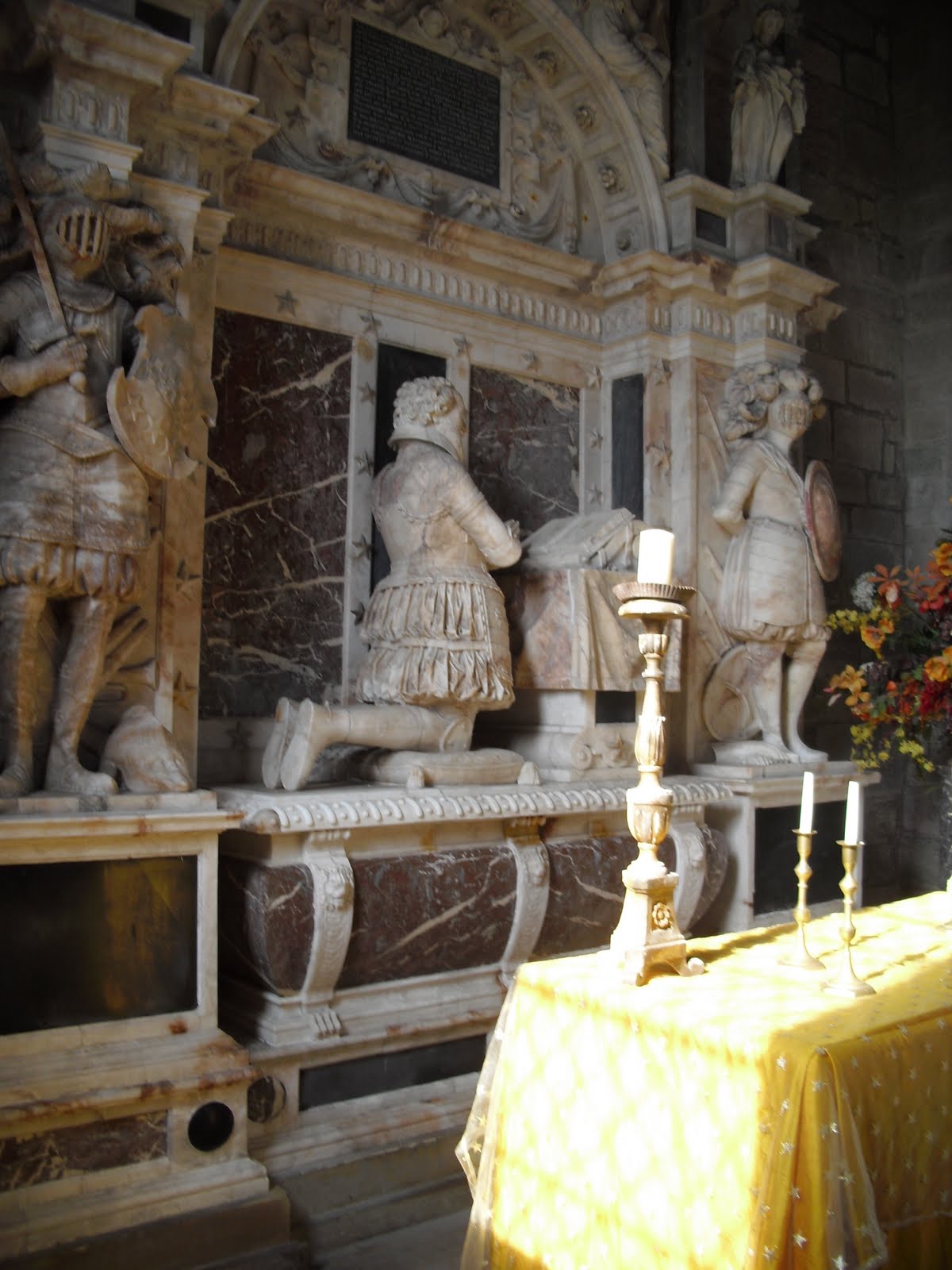
The chapel sits on Boot Hill, supposedly the ancient Scottish coronation site (where the Stone of Scone used to sit. It is perhaps apocryphally composed of soil brought from around Scotland in the boots of the local lords, because convention dictated that they swear loyalty standing on their own land. The lords would then empty out their boots on the site. I'm skeptical. Back when I was a tour guide, this is exactly the sort of thing we used to make up. It's too good to be true.
 There is a Pinetum.

What is a Pinetum, you ask? According to the web site:
Stroll at your leisure through the magnificent Pinetum where, amongst others, giant redwoods and Noble Firs tower over you then onto the New Pinetum of less hardy and decorative conifers. One of the finest trees here at Scone is a giant Douglas Fir which was raised from the first seed sent home from North America by David Douglas in 1826.Which doesn't really clear the matter up much, but here's a picture of the Douglas Fir.

 This fir may be the long-lost cousin of the similarly-appendaged Tembusu Tree from the Singapore Botanical Gardens.
There is a maze shaped like a star.

 Justin says: Left or right?

Nana says: Gaaaah!
 Ultimately, victory was ours:

20 May 2010
Perth, Part One: Perth Museum and Art Gallery; Street Fair
A couple weeks ago, Nana and I headed up to Perth for yet another day of nerding about.
Perth is the adminstrative seat of Perth and Kinross, a council district made up of the traditional counties of sprawling Perthshire and tiny Kinross-shire. Perthshire straddles the Highland Line, so the county is low and fertile in the east, rugged and rocky in the west. Perth itself sits on the River Tay at the furthest point upriver you can reliably sail, and historically it served as an important port for the area, with trade connections reaching down the east coast of Britain and all the way to the Continent.

Today, Perth is a sleepy town, dependent mostly on tourism, as its location makes it a popular base for exploring the southeastern part of the Highlands.
Perth itself, however, is not without its attractions, foremost among which is a charming local museum. The Perth Museum and Art Gallery houses several interesting collections. The largest single exhibit we visited was of a collection of archaeological finds from in and around Perth, focusing mostly on everyday life in the medieval town. Of course, the exhibit also had the obligatory opportunity for playing dress-up . . . this seems to be a British thing!


An adjacent exhibit details local arts and crafts . . .


. . . including a life-sized sheep made of glass tubes (of course).

They also had a cabinet of communion tokens from the Church of Scotland and its (many, many, many) offshoots around the world . . . including Pittsburgh!

Communion tokens are an odd little quirk of many Protestant congregations. Communion was a big occasion, usually annual, and before partaking churchgoers had to pass a religious test (of orthodoxy, loyalty, etc) and had to present their tokens for admission to the communion ceremony. Often, tokens required a small donation, and were thus also used as fundraisers for their respective churches. The practice was at its peak in the 19th century.
After a couple hours in the museum, Nana and I stumbled upon a street fair in Perth's main pedestrian shopping district--a perfect opportunity for lunch!

And it seems British multiculturalism has reached as far as Perthshire these days: after walking past huge vats of paella and Chinese noodles . . .

. . . we settled on a Polish stew of beef, sausage, and cabbage for the main course . . .

. . . and a selection of Turkish pastries for dessert.
 Yum!
Perth is the adminstrative seat of Perth and Kinross, a council district made up of the traditional counties of sprawling Perthshire and tiny Kinross-shire. Perthshire straddles the Highland Line, so the county is low and fertile in the east, rugged and rocky in the west. Perth itself sits on the River Tay at the furthest point upriver you can reliably sail, and historically it served as an important port for the area, with trade connections reaching down the east coast of Britain and all the way to the Continent.

Today, Perth is a sleepy town, dependent mostly on tourism, as its location makes it a popular base for exploring the southeastern part of the Highlands.
Perth itself, however, is not without its attractions, foremost among which is a charming local museum. The Perth Museum and Art Gallery houses several interesting collections. The largest single exhibit we visited was of a collection of archaeological finds from in and around Perth, focusing mostly on everyday life in the medieval town. Of course, the exhibit also had the obligatory opportunity for playing dress-up . . . this seems to be a British thing!


An adjacent exhibit details local arts and crafts . . .


. . . including a life-sized sheep made of glass tubes (of course).

They also had a cabinet of communion tokens from the Church of Scotland and its (many, many, many) offshoots around the world . . . including Pittsburgh!

Communion tokens are an odd little quirk of many Protestant congregations. Communion was a big occasion, usually annual, and before partaking churchgoers had to pass a religious test (of orthodoxy, loyalty, etc) and had to present their tokens for admission to the communion ceremony. Often, tokens required a small donation, and were thus also used as fundraisers for their respective churches. The practice was at its peak in the 19th century.
After a couple hours in the museum, Nana and I stumbled upon a street fair in Perth's main pedestrian shopping district--a perfect opportunity for lunch!

And it seems British multiculturalism has reached as far as Perthshire these days: after walking past huge vats of paella and Chinese noodles . . .

. . . we settled on a Polish stew of beef, sausage, and cabbage for the main course . . .

. . . and a selection of Turkish pastries for dessert.

13 May 2010
And we have a government!
To briefly recap - in the UK parliamentary system, the Prime Minister is the head of the party with an absolute majority (326 seats) in Parliament. If no single party gets a majority, this creates a "hung Parliament." The parties then enter into negotiations to form a coalition with other parties until the necessary number of seats can be cobbled together.
Britain's last election, as I blogged before, ended in just such a hung Parliament. The Liberal Democrat party had to choose whether to ally with the Conservatives, which would immediately result in a new government, or ally with Labour, which would require a few other fourth-party MPs to throw in their hats. Negotiations were pretty intense. Labour leader and former PM Gordon Brown resigned as head of his party, possibly to give the Lib Dems a way to ally with Labour while plausibly maintaining their position as the party of change. (Brown resigned while I was at work, prompting cheers from certain Labour-supporting employees. Dancing around the office while singing "Bye-bye Brownie" may have also occurred).
Labour labored (har!) in vain, however. The Conservatives and the Lib Dems have agreed on a deal. Much of their platform is available here but some interesting highlights, at least as far as I'm concerned, are:
- eliminating the proposed National ID Card system and the next-generation RFID passports.
- capping non-EU migration. (This may or may not be terribly helpful, as many of Britain's unpopular immigrants are from the EU, or at least aren't here legally in the first place)
- officially pledging not to join the Eurozone
- planning to convert current welfare programs into welfare-to-work (the idea kicked around during the campaign was to strip benefits from anybody able to work who rejected three job offers; not sure if that's what they'll settle on or not).
- reforming schools, particularly by allowing local start-up schools similar to US charter schools.
- retaining Trident, the British nuclear sub program
There's lots more in there but those are some juicy/controversial bits. What will actually be translated into policy is anybody's guess.
Subscribe to:
Posts (Atom)
