Showing posts with label homes_gardens. Show all posts

22 May 2010

Perth/Scone Palace, Part the Last (Probably): Baby, I'm A-Mazed

The gardens at Scone Palace are so remarkable that you can actually pay a separate admission just to go to the grounds. I'm not sure why you would, though, since nobody seems to be paying any attention to the back gate. (But you didn't hear it from me).

There is, as shown in a previous post, a lovely set of cherry trees:


For the deceased visitor, I recommend the graveyard and the family chapel. Most of the stones I remember seeing in the graveyard were nineteenth century, but that may be selection bias: the most recent stones are the easiest to read, and therefore the ones I saw and remembered. That doesn't mean that there weren't older ones there.


The chapel sits on Boot Hill, supposedly the ancient Scottish coronation site (where the Stone of Scone used to sit. It is perhaps apocryphally composed of soil brought from around Scotland in the boots of the local lords, because convention dictated that they swear loyalty standing on their own land. The lords would then empty out their boots on the site. I'm skeptical. Back when I was a tour guide, this is exactly the sort of thing we used to make up. It's too good to be true.

There is a Pinetum.


What is a Pinetum, you ask? According to the web site:
Stroll at your leisure through the magnificent Pinetum where, amongst others, giant redwoods and Noble Firs tower over you then onto the New Pinetum of less hardy and decorative conifers. One of the finest trees here at Scone is a giant Douglas Fir which was raised from the first seed sent home from North America by David Douglas in 1826.
Which doesn't really clear the matter up much, but here's a picture of the Douglas Fir.


This fir may be the long-lost cousin of the similarly-appendaged Tembusu Tree from the Singapore Botanical Gardens.

There is a maze shaped like a star.


Justin says: Left or right?


Nana says: Gaaaah!

Ultimately, victory was ours:

04 May 2010

Scone Palace: The Stone of Scone

(Scone, by the way, is pronounced "skoon" by the guides at Edinburgh Castle but "scohn" by my Shetlander friend - see here for more on accents)

Scone Palace, which I briefly mentioned before, belongs to the Earl of Mansfield. It's a 19th century building on the site of the old Scone Abbey. General rule of thumb when dealing with British architecture: if it looks the way you think something medieval should look, it's 19th century (and usually Victorian). Genuinely medieval things are, for the most part, ruins.

The interior at the Palace (technically more of a manor house, but that doesn't draw the tourists) is quite interesting and a fun visit. You can see the chamber where Queen Victoria slept, a remarkable collection of ivories and porcelains, and pictures of the family past and present. You can't take photographs inside, however, so we just have some shots of the grounds.

The kings of Scotland were traditionally crowned at the former Abbey while seated on the Stone of Scone, reputed to be Jacob's pillow from the Bible. It's also called the Stone of Destiny, which I always hear in my mind in the same squeaky voice as the pigs from Babe saying "PIG..... OF..... DESSTINYYYYY." But we already know I have problems.

"Stone of Destiny" is "Lia Fail" in Gaelic, and, as many Scottish icons do, has a beer named after it. (Justin's verdict for said beer. which he sampled last fall - "Meh.")

In any case, in 1296, the English King Edward I (the bad guy from Braveheart) pilfered the Stone and took it back to England as part of his campaign to subdue the Scots. No crowning stone, no crowned king, as the logic went.

According to my grandfather's genealogy research, my family is vaguely descended from Edward I. Blood, as they say, will out, and overcome by family tradition, I attempted to make off with the replica Stone.

I may have been more authentic than I knew, as my great-great-whatever-grandfather may also have targeted a replica. It is said that Edward's stolen Stone was a substitute, sneaked into Scone by Scottish subversives, while Scone Abbey monks secretly submerged the original in the River Tay.

The Stone generally believed to be the original resides today at Edinburgh Castle, but it has been a bit of a circuitous journey. It was lodged in a chair used in the English coronation ceremony at Westminster Abbey, thereby integrating (or coopting, depending on your point of view) the Scottish tradition for the joint monarch of England and Scotland after the 1707 Act of Union. It remained there until the 1950s, when radical students stole it, but eventually gave it back. There's a move about this called Stone of Destiny; for trivia buffs, it stars not only Billy Boyd, but also Kate Mara, descended from the American families which own the Steelers and the New York Giants.

The Stone finally made it back to Scotland in 1996 in what the Edinburgh Castle tour guides describe as a failed attempt by the Conservative Party to buy off Scottish voters. The agreement states that the stone will be loaned back to Westminster for the next royal coronation; Scots like to joke that they will send it back tied to a string.

Here in the cafe beneath the palace, Justin consumes a scone. A Scone of Scone. (Justin's verdict: "6.5/10. I prefer crumbly. The jam was good, though.")

We're pretty sure this means that Justin is now the king of Scotland.

31 March 2010

Newhailes & the Scottish Enligthenment

Most tourists, when they think of Scotland, probably think of kilts and whiskey, or haggis and the Highlands. Be honest, if I just said the word "Scottish," you'd probably picture something like this:

 (GIS for "Scottish," first entry.) 

For a lot of Scottish history, though, many folks might have pictured something like this:

That, my friends, is Lord Dalrymple and son, two generations of the family that built Newhailes House, just outside Edinburgh.

You see, for much of the 18th century, Edinburgh was one of the great cultural capitals of Europe. Dubbed the "Athens of the North," Edinburgh was home to some of the most important scholars of the Enlightenment, such as Adam Smith and David Hume.
(Notice: no kilt.)

During this time, Edinburgh's cultural influence extended throughout Europe and beyond, and some of the leading lights of the day continue to influence modern politics and philosophy.

This "Scottish Enlightenment," as it would come to be called, succeeded largely through the patronage of powerful families like the Dalrymples. Such patrons not only provided political protection and financial support: in many cases, they were amateur scholars themselves, and the collections they had amassed served as important libraries for Enlightenment scholars.

The library at Newhailes House in East Lothian was one such establishment, drawing a number of scholars from nearby Edinburgh, including the aforementioned David Hume and Adam Smith. For this reason, my class on the Enlightenment took a field trip to Newhailes last week for a private guided tour.

In many ways, Newhailes is a typical Enlightenment retreat: built within a short ride of Edinburgh, the house projects both impressive wealth and a sense of isolation and rural repose. Don't be fooled, though, Newhailes is actually on the small side for homes of its type--its facade may be imposing, but the house is only one room deep.

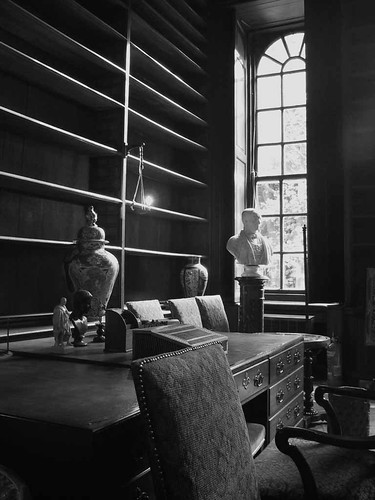
Nevertheless, the interior doesn't disappoint. The two-storey library accounts for about one-third of the house, and definitely had me green with envy.

(From Flickr--no cameras allowed in the house.)

Alas, the books, for the most part, are gone--shipped off to the National Library to pay death duties. There's still an interesting little collection in the sitting room at Newhailes, but the shelves of the library proper are bare. Sad, but oddly evocative, and at least now the books are easily available to the public.

30 January 2010

Malta: Where Everybody Knows Your (House's) Name

In Malta and Gozo, they name their houses. I'm not sure if this is a borrowing from the UK, where many jurisdictions use house or estate names instead of numbered street addresses, or if it predates British influence. But whereas in my experience the practice normally applies to standalone structures in the UK, in Malta even townhouses and semi-detached homes are named.

Usually, the names are displayed on pretty little ceramic plaques near the front door. Many of the names reflect Malta's Catholic heritage; others reflect its popularity among second-home owners from elsewhere in Europe.

The style of the house-name plaques has also been picked up for street signs and other public signage, which has the doubly pleasant effect of making them less obtrusive and much nicer to look at.


(Stick No Bills)


("Police")


("Cathedral Plaza")
(Probably a family name? "Of the" Arlekkins?)

("The Merrill")


20 December 2009

Stirling: the Church of the Holy Rude, Argyll's Lodging, Mar's Wark, and more!

Earlier this week, Nana and I took a day trip to nearby Stirling, home of Stirling Castle (previous post). Stirling is more than just a castle, though, and the city's ample historical markers make the whole Old Town like an outdoor museum. In this post, we'll take a look at some of the Old Town's other sites.

Mar's Wark and the Erskine Church

Our first stop was Mar's Wark, a ruined 16th-century townhome built by one of the Earls of Mar, who were of the Erskine clan, making them Nana's distant distant relatives. The resemblance is uncanny.


The Earls of Mar were the keepers (stewards, basically) of Stirling Castle; this particular earl had also been the Regent of Scotland while James VI was growing up. He was a powerful dude.

The house itself would have been magnificent in its heyday. It had enormous windows with splendid views, ornate stone carvings (check out the mermaids below), and a prime location right between the Church of the Holy Rude and the castle.


Mar's Wark fell into disrepair after one of the later earls forfeited the home by supporting the Jacobites in 1715. The home was used as a barracks during the 1745 Jacobite Rising and suffered considerable damage during that conflict.


But 1715 wasn't the end of the Erskines in Stirling: in 1733, one Ebenezer Erskine, a radical Presbyterian, broke away from the Church of Scotland and established his own church just down the street from the Church of the Holy Rude. The original Erskine Church was replaced by a newer structure of the same name in 1825. Now, the building is a youth hostel.

Church of the Holy Rude

The Church of the Holy Rude has been Stirling's parish church for nearly 900 years. The name features the Scots version of the English "rood," referring to the cross. James VI was crowned here in 1567, making the Church of the Holy Rude one of only two still-operating churches in Britain that have been host to a coronation.


The Church is also the site of an impressive kirkyard, dating mostly from the 19th century. In the left background of the shot above, you can see the back of Mar's Wark.


Argyll's Lodging
Argyll's Lodging, literally a stone's throw away from Mar's Wark, is a well-preserved and partially restored 17th-century townhouse. The current building is the result of the 9th Earl of Argyll's expansion of an existing L-shaped tower house in the 1670s.

That tower house had belonged to William Alexander, 1st Earl of Stirling, the man behind Scotland's first (failed) colonies in Nova Scotia, and also the progenitor of Nova Scotia's name, flag, and coat of arms. You can see a version of that coat of arms over the door below: the design features a Native American on the left and a mermaid on the right. This motif appears again a few other times throughout the house.


Argyll's renovations demonstrate the man's devotion to French design. For example, his house featured what it generally believed to be the first wooden staircase in Scotland. Argyll also made extensive use of the newfangled drop-leaf tables you see in the picture below.


Now, these days drop-leaf tables usually say "I live in a tiny apartment and I shop at Ikea." In Argyll's day, they said "The heck with this, let's dance!" You see, judicious application of drop-leaf technology could turn your average dining room into a dance hall in seconds flat.

 
Today, Argyll's Lodging is managed by Historic Scotland as part of the Stirling Castle property. One ticket lets you visit both sites.

Old Town Jail

If there's anything Victorians love more than anachronistic Gothic-style architecture, it's repressing people for their own good. So it's not surprising that the leaders of Victorian Stirling poured time and money into a new-model jail/insane asylum/poorhouse shaped vaguely like a medieval castle.


These days, the Old Town Jail is a kid-centered tourist attraction featuring dozens of historical re-enactors. It was closed for renovations during our visit, but the jail's grounds allow for a pleasant stroll.

Of course, even though we were only at the jail for ten minutes, Nana couldn't help running afoul of the law. 


21 November 2009

Lindisfarne Castle


It just occurred to me that Nana and I are headed on a new day-trip adventure tomorrow, and we still haven't finished blogging about the last two! So without further ado, here's another installment on Lindisfarne (you can find the first post here.) This post will deal with Lindisfarne Castle; a future post, I hope, will touch on the silliness surrounding the Lindisfarne causeway.


First, calling Lindisfarne Castle a castle is a bit of a misnomer: it's a tiny thing, really more of a fort, perched on an incongruous crag that juts out of a low field at the southern end of the island.


The castle, originally built in the 16th century, is the smallest of a string of fortresses along the coast of Northumberland designed to protect the surrounding countryside and, more importantly, the sea lanes from the Scots. Lindisfarne Castle stands guard over a natural harbor that was used as a staging area for various campaigns throughout the 16th, 17th, and 18th centuries.


It also stands guard over several very strategic sheep.

Lindisfarne had at least a small role to play in nearly every major conflict in Britain during those centuries: the castle and its nearby harbor were used during the time of the Border Reivers, the English Civil Wars, and pretty much every last one of the half-dozen Jacobite Risings between 1688 and 1745. It was during this latter period that Lindisfarne Castle was somewhat farcically captured by an overwhelming force of two rowdy Jacobites who managed to hold the fort for about a day before surrendering to Hanoverian troops.

In the 1900s, the castle was converted into an utterly idiosyncratic country home, which now belongs to the National Trust. When we visited, they had a little Halloween scavenger hunt running, in which children (and childish adults like us) were tasked with finding a selection of ghoulish little things that had been hidden throughout the property.

At the foot of the castle, you can a modern example of some traditional Northumbrian architecture: a row of sheds made from the bottoms of herring boats that have been cut in half. Easy to waterproof and aerodynamic, both of which are important if you want your stuff to live through a winter on the North Sea!