Showing posts with label Georgian. Show all posts

31 March 2010

Newhailes & the Scottish Enligthenment

Most tourists, when they think of Scotland, probably think of kilts and whiskey, or haggis and the Highlands. Be honest, if I just said the word "Scottish," you'd probably picture something like this:

 (GIS for "Scottish," first entry.) 

For a lot of Scottish history, though, many folks might have pictured something like this:

That, my friends, is Lord Dalrymple and son, two generations of the family that built Newhailes House, just outside Edinburgh.

You see, for much of the 18th century, Edinburgh was one of the great cultural capitals of Europe. Dubbed the "Athens of the North," Edinburgh was home to some of the most important scholars of the Enlightenment, such as Adam Smith and David Hume.
(Notice: no kilt.)

During this time, Edinburgh's cultural influence extended throughout Europe and beyond, and some of the leading lights of the day continue to influence modern politics and philosophy.

This "Scottish Enlightenment," as it would come to be called, succeeded largely through the patronage of powerful families like the Dalrymples. Such patrons not only provided political protection and financial support: in many cases, they were amateur scholars themselves, and the collections they had amassed served as important libraries for Enlightenment scholars.

The library at Newhailes House in East Lothian was one such establishment, drawing a number of scholars from nearby Edinburgh, including the aforementioned David Hume and Adam Smith. For this reason, my class on the Enlightenment took a field trip to Newhailes last week for a private guided tour.

In many ways, Newhailes is a typical Enlightenment retreat: built within a short ride of Edinburgh, the house projects both impressive wealth and a sense of isolation and rural repose. Don't be fooled, though, Newhailes is actually on the small side for homes of its type--its facade may be imposing, but the house is only one room deep.

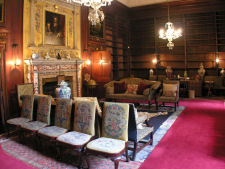
Nevertheless, the interior doesn't disappoint. The two-storey library accounts for about one-third of the house, and definitely had me green with envy.
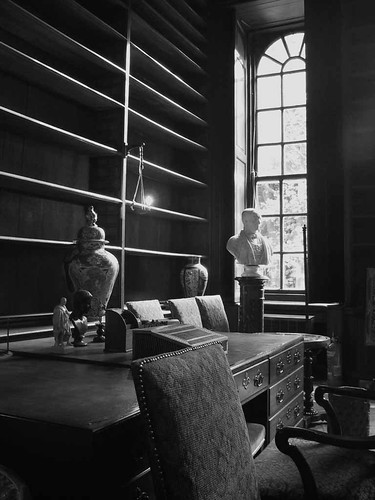
(From Flickr--no cameras allowed in the house.)

Alas, the books, for the most part, are gone--shipped off to the National Library to pay death duties. There's still an interesting little collection in the sitting room at Newhailes, but the shelves of the library proper are bare. Sad, but oddly evocative, and at least now the books are easily available to the public.

21 March 2010

Craigmillar Castle Pt. 1 - Take a Hike

Justin and I went out to Craigmillar Castle last weekend, thus proving that it's worth buying the multipass (in this case, a Historic Scotland membership) because then you'll be darned if you don't get your money's worth out of it. Justin told me we could walk out to the castle. It was close, he said. It'd be a nice day for a stroll, he said. It was one and a half hours, he didn't say.

Perhaps this is why he chose to dress in camouflage for the occasion:

In all fairness, the first forty-five minutes was a lovely, level walk around Arthur's Seat. Scotland may not be full of bright tropical colors, but there is a surprising diversity of earth tones. Count how many shades of green and brown you find in that picture. There's something quite beautiful about it, in a subtle and rugged way.

The path we followed used to be the old Edinburgh and Dalkeith Railway, nicknamed the "Innocent Railway" because... well, depends on who you ask. The Gazetteer for Scotland says it's because of the railway's excellent safety record. The sign on site says it's because it still used horses (also an alternative explanation given by the Gazetteer). Yes, that's right, a horse-drawn train. I suppose the coal-shovelers had slightly different duties here.

The original function of the railway was to bring coal into Edinburgh for urban consumption, but passenger soon latched onto it as a good deal. With the horse-drawn pace, there was no need for formal stations. Passengers could choose to disembark anywhere along the route. The railway also offers a contender for the position of oldest railway tunnel in Britain, but not in the part we walked.

Some sections are still in use, adapted and incorporated into other railway lines, but the section on the way to Craigmillar was decommissioned in 1968 and turned into the present walking/bicycling path.

With, of course, the odd train (and the emphasis here is on "odd"):

Chooga chooga chooga chooga chooga chooga chooga chooga...

Choo-choooooo!


What do you mean, I'm not five years old anymore?

21 November 2009

Lindisfarne Castle


It just occurred to me that Nana and I are headed on a new day-trip adventure tomorrow, and we still haven't finished blogging about the last two! So without further ado, here's another installment on Lindisfarne (you can find the first post here.) This post will deal with Lindisfarne Castle; a future post, I hope, will touch on the silliness surrounding the Lindisfarne causeway.


First, calling Lindisfarne Castle a castle is a bit of a misnomer: it's a tiny thing, really more of a fort, perched on an incongruous crag that juts out of a low field at the southern end of the island.


The castle, originally built in the 16th century, is the smallest of a string of fortresses along the coast of Northumberland designed to protect the surrounding countryside and, more importantly, the sea lanes from the Scots. Lindisfarne Castle stands guard over a natural harbor that was used as a staging area for various campaigns throughout the 16th, 17th, and 18th centuries.


It also stands guard over several very strategic sheep.

Lindisfarne had at least a small role to play in nearly every major conflict in Britain during those centuries: the castle and its nearby harbor were used during the time of the Border Reivers, the English Civil Wars, and pretty much every last one of the half-dozen Jacobite Risings between 1688 and 1745. It was during this latter period that Lindisfarne Castle was somewhat farcically captured by an overwhelming force of two rowdy Jacobites who managed to hold the fort for about a day before surrendering to Hanoverian troops.

In the 1900s, the castle was converted into an utterly idiosyncratic country home, which now belongs to the National Trust. When we visited, they had a little Halloween scavenger hunt running, in which children (and childish adults like us) were tasked with finding a selection of ghoulish little things that had been hidden throughout the property.

At the foot of the castle, you can a modern example of some traditional Northumbrian architecture: a row of sheds made from the bottoms of herring boats that have been cut in half. Easy to waterproof and aerodynamic, both of which are important if you want your stuff to live through a winter on the North Sea!