Showing posts with label 1800s. Show all posts

21 November 2009

Lindisfarne Castle


It just occurred to me that Nana and I are headed on a new day-trip adventure tomorrow, and we still haven't finished blogging about the last two! So without further ado, here's another installment on Lindisfarne (you can find the first post here.) This post will deal with Lindisfarne Castle; a future post, I hope, will touch on the silliness surrounding the Lindisfarne causeway.


First, calling Lindisfarne Castle a castle is a bit of a misnomer: it's a tiny thing, really more of a fort, perched on an incongruous crag that juts out of a low field at the southern end of the island.


The castle, originally built in the 16th century, is the smallest of a string of fortresses along the coast of Northumberland designed to protect the surrounding countryside and, more importantly, the sea lanes from the Scots. Lindisfarne Castle stands guard over a natural harbor that was used as a staging area for various campaigns throughout the 16th, 17th, and 18th centuries.


It also stands guard over several very strategic sheep.

Lindisfarne had at least a small role to play in nearly every major conflict in Britain during those centuries: the castle and its nearby harbor were used during the time of the Border Reivers, the English Civil Wars, and pretty much every last one of the half-dozen Jacobite Risings between 1688 and 1745. It was during this latter period that Lindisfarne Castle was somewhat farcically captured by an overwhelming force of two rowdy Jacobites who managed to hold the fort for about a day before surrendering to Hanoverian troops.

In the 1900s, the castle was converted into an utterly idiosyncratic country home, which now belongs to the National Trust. When we visited, they had a little Halloween scavenger hunt running, in which children (and childish adults like us) were tasked with finding a selection of ghoulish little things that had been hidden throughout the property.

At the foot of the castle, you can a modern example of some traditional Northumbrian architecture: a row of sheds made from the bottoms of herring boats that have been cut in half. Easy to waterproof and aerodynamic, both of which are important if you want your stuff to live through a winter on the North Sea!

17 November 2009

Sartorial Mythbusting, Part 1: Clan Tartans

When you think of Scotland, you probably think of many things. Haggis. Bagpipes. Rain. But I'm going to go out on a limb here and guess that your most thought-of Scotland image is tartan, often also called plaid.

Ah, the tartan! What a glorious tradition, each clan to its own tartan! Imagine them running over Culloden Field in their Highland Charge, displaying to the enemy which families were arrayed against them! How tragic it was when the plaids were banned for most of the rest of the 18th century!

Except not. Time for some sartorial (i.e., clothing) mythbusting!

Here is a portrait of John Campbell, from 1749:

We have a problem here. The Campbell plaid, as we know it, is predominantly blue, green, and white, and looks like this.
So he is definitely not wearing Campbell plaid. (In fact, he's wearing two plaids that aren't "Campbell plaid" – your eyes may be watering too hard from that outfit to tell, but those tartans are different top and bottom). Why not?
Campbell plaids did not exist in the 18th century. Neither did Stewart plaids, or MacDonald plaids, or MacIntosh plaids, or any other form of official standardized clan plaids. There were very likely regional variations caused by the availabilities of dyes and local weaving techniques, but the official tartans as we know them are a product of the early 19th century, specifically of a firm called Wilson's of Bannockburn.
At that time, Scotland was hot. Highland regiments won renown for their fighting against Napoleon. Sir Walter Scott's 1814 book Waverley romanticized the '45 uprising like dang and whoa. King George IV even came to Scotland in 1822, and wore tartan! Wilson's knew a good trend when they saw it, and began weaving like crazy on those newfangled industrial looms. This, by the way, is another nail in the coffin for the "plaids as traditional Highland attire" argument – the plaids we see today are completely beyond the capacity of a Highland homespinner, both in weaving and dyeing. (Want to try some virtual weaving yourself? See links below!)
Soon, Wilson's's ('s's's's) tartans were flying off the shelves. To keep track of all the patterns, or perhaps to simply merchandise them better, the tartans were given clan names. The final capping touch on this was the forgery of the Vestiarium Scoticum (a book, and not a skin condition, although it sounds like one) by John Sobieski Stuart and Charles Edward Stuart, two brothers who claimed to be the descendents of Bonnie Prince Charlie. The book, which they said came from an old manuscript, claimed to lay out pre-Culloden tartans by clan. As fake royals trying to bond with the local population and score some freebies like room and board, the Sobieski Stuarts probably claimed this faux sartorial (word of the day!) expertise to shore up their Scottish street cred.
Need more evidence? Look at the 1746 David Morier painting of Culloden, in which the Scots clearly are not wearing organized plaids. The tartans shown also do not align to the 19th century plaids assigned to the clans we know were at the battle. (There are also some more amazingly eyewatering tartan-on-tartan outfits here – I'm surprised the Hanoverian side could see to aim their muskets.) Eyewitness accounts of the battle support the painting as well. The Jacobites were distinguished by white bonnets, or the berets with white bows shown in the painting. After the battle was lost, the vanquished frequently ditched the bonnet to pass for Royalists. Clearly, this would not have worked if the other 8/10ths of your outfit screamed "Member of a Jacobite Clan."
Some people don't deal well with this revelation. My professor recounted giving a presentation on the above portrait of Campbell and receiving a question from a man who wanted to point out to her that it couldn't be John Campbell, since it wasn't a Campbell plaid. She explained what I've just gone over here – that the "Campbell plaid" is 19th century construction, etc., etc., and he nodded and nodded, and when she finished, he said, "I understand what you're saying, Professor, but that's not a Campbell plaid." The tourist industry also is very fond of the tartan system, as it enables them to sell mass quantities to Scottish diaspora tourists seeking a bit of heritage to take back. (Which is completely fine with me - the tartan can still connect you to Scottish heritage, or to other wearers, or can just look fun, regardless of what year it was designed. I like tartan. I just want to point out its real history.)
Nowadays, tartans are policed very seriously by the Scottish Register of Tartans, which you can think of as a patent bureau for tartan patterns. If you made a tartan using Tartan Maker or Tartan Designer or Interactive Weaver (go on, it's a hoot) or another progam, I'm sorry to say you can't just declare it your tartan and start making kilts. You must submit it (and pay a fee), and have your submission approved as different enough from all existing tartans to justify its own registration. With everyone from Alberta to Zambia getting in on the act, you can imagine things get tighter every year.
By "policed," though, I don't mean that people will come and tear a tartan off you if they don't you deserve it. Mostly it relates to manufacture and naming rights. People "in the know" would frown on wearing the royal family's three Balmoral tartans if you're not actually a royal (they won't even manufacture them for you in the UK), but tartan-wearing is basically self-policing. If you want to wear one just because you like it, I don't think people would mind. Just don't lie and say you're their long-lost cousin
Coming up next time: the "banning" of the Tartans, and what is a plaid?

15 October 2009

Edinburgh Castle

(Sorry, Jillian, I have no creative titles for this one!)
Justin and I joined up with a trip sponsored by the Edinburgh University History Society that got us discounted admission to Edinburgh Castle, site of much history and many tourists. Unfortunately, this trip and tour were a long time ago, and I've been remiss in getting them posted, so I have no idea how much I'll remember.
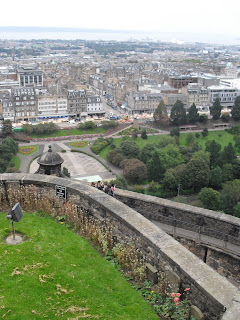
Edinburgh Castle sits high above the city of Edinburgh. How high, you ask, especially Justin's skeptical Pittsburgh relations, whose driveways frequently rate as black diamonds come winter?

That high. I think even Pittsburghers must be impressed.

With the hill, and the commanding view of the water, one can therefore guess that this has been an important defensive position for a significant period of time. One would be correct. Way to go, one! According to the castle web site, the oldest evidence of human settlement on the castle hilltop dates back to 900 BC, with the fortress "Din Eidyn" ("Edwin's Fort") first appearing around 600 BC.

(Side note to Tolkein nerds: Din Eidyn... Dunedain. Warrior men of the North. Make your own call).

The oldest building on site, going back to 1130, is St. Margaret's Chapel, a tiny whitewashed stone room dedicated to the former queen of Scotland. You can just make it out on the far right of this image here. See how the texture of the stone is rougher?


Nearby you can find Mons Meg, a 550 year old medieval siege gun built at Mons, Belgium, and quite frankly not something I would have liked to have had to lug up the hill. I am, however, perfectly happy to pose around it in various undignified ways.


Nor would I have liked to have lugged the ammunition.


The castle was the site of several important battles during what Americans best know as "the Braveheart period," AKA the reign of Edwards I through III. (As our tour guide at the castle put it, "There are three types of movies: movies which tell the history, movies which are based on the history but take some liberties, and movies which make no attempt at historical accuracy whatsoever. Braveheart falls into the third category.") The relevance of the castle at this time is demonstrated by the following text from the castle web site:
1296
Edward I of England invades Scotland, capturing the
castle after a three-day siege.

1314
The Scots, under Robert the Bruce, recapture the castle.

1334
The English retake the castle.

1341
The Scots take it back again.
If I recall correctly, at least one of these sieges involved people boiling human waste to fling down on the enemy at the castle gates. Hey, why waste oil or pitch?
The Great Hall was built in 1511. Justin and I spent most of the time in there having flashbacks to Yale College dining halls, and wondering if we had remembered to swipe our meal cards.


(That's Edinburgh Castle at the top, Yale below).

King James I of England (James VI of Scotland, which, let's face it, is pretty irritating to keep track of) was born at the castle, in a tiny little chamber which we did not photograph, as indoor photography is frowned upon. It was tiny, and entirely paneled in painted wood, with a nice view down off the hill that I bet his mother Mary got awfully tired of while stuck in there in labor.

As they did at many UK historical sites, the Victorians took it upon themselves to improve upon the original. Here, you can see how a medieval wall becomes, halfway up, a Victorian addition:

The castle is also home to the Scottish National War Memorial


and the Honours (with a U!) of Scotland, which in English means the crown, sceptre (not scepter!), and sword of the monarchs of Scotland, along with some really nice royal jewelry. It is an interesting quirk of history, I think, that Scotland maintained its independence in the wake of the wars mentioned above - the not-really Braveheart wars. It was only after James VI went over to become James I (I told you that would be annoying) that the shenanigans started. You would think that a Scottish family on the throne of England would be good news for the Scots, but alas, it was not to be. (Although in all fairness, you could probably say that the problems really began when the Scottish family came off the throne; see Justin's earlier post for review. There will be a quiz.)


Yes, that's me in the lower right. Do you think I would make a good guard? See how vigilant I am!
On second thought, no. It was too cold.

01 October 2009

The Field of Storms and The Black Isle

At last, the final installment of our Highland adventures! You can find the other posts here:
This post is in two parts: the first covers the tiny Highland hamlets of Ledgowan and Achnasheen, which we visited on our way to Skye; the second covers our day trip around the Black Isle, which is actually a peninsula just northeast of Inverness.

Ledgowan and Achnasheen

Our first stop on the Skye day trip was here, in the aptly-named Field of Storms (Gaelic: achnasheen), at the foot of one of the few passes over the spine of the Highlands south of the northern coast and north of Loch Ness.


Seriously, check out the satellite view on Google Maps: nothing but miles and miles of heather. Achnasheen and Ledgowan are where the little orange road at the bottom forks.

View Larger Map

The prevailing westerly winds howl down through said pass and over Achnasheen fast enough to make a grown man unsteady on his feet. Hence all those trees you see aren't just for decoration: they're there to make it possible to hear yourself think on the way from your door to your car.

Now, having, like most American young men, seen Braveheart about a billion times, I was interested to see how different the Scottish Highlands look from how they're depicted in the film. The Highlands are not actually green--they just filmed mostly in the green bits, and in Ireland.

No, in reality, the highlands are brown and purple (yes, purple, thanks to the heather).

The Highlands (or at least the parts that are actually high) are also remarkably barren, something more like what you'd expect from the American West. There's simply a lot more space than you'd expect to find anywhere in such a small country.

It's worth noting, however, that the Highlands aren't quite a wilderness, in that the Highlands as they are today are largely man-made: the slopes above used to be covered about halfway up with forests of Scots pine, but the earliest settlers (we're talking prehistoric here) clear-cut the place even before Scotland passed into the historical record.

In many of the more sheltered glens, there has been an effort to replant, both for environmental and commercial reasons, but the Field of Storms is largely out of luck thanks to the wind.


The Black Isle

The Black Isle isn't an island: it's actually a peninsula between the Cromarty Firth and the Moray Firth, just north of Inverness. No one is sure how it got its name--some say it was a late stronghold of witchcraft, some say the forests along its coasts made it look black--but my money's on the place being named after the extremely dark, extremely fertile soil, which made the Black Isle one of the breadbaskets of the Highlands.


We toured the Black Isle for a morning in the open top of a double-decker bus, which was terrible for the body temperature, but absolutely perfect for grooving to the Highland tunes they piped in on our audio tour headsets.

Wait, is that . . . ? Yes, it is! The Schecky dance (sp?) in the Highlands!

Our first stop of the morning was at the ruined priory of Beauly (from the French beau lieu), established by Norman monks around 1230.

Beauly Priory is built of the same Old Red Sandstone prominent throughout the Eastern half of the highlands, giving it a distinctly pink hue.

From Beauly, we continued on to Cromarty, an old fishing village at the tip of the Black Isle, where the Cromarty Firth branches off from the Moray Firth. In the background of the picture below are the Sutors of Cromarty, two high bluffs marking the entrance to the Cromarty Firth. Today, the Firth is actually used to store and repair North Sea oil rigs; the narrows by the Sutors keep the waters of the Firth calm year-round.


Cromarty's restored courthouse is also home to an excellent local history museum.
Cromarty spent most of its history as a royal burgh, which means it had a measure of urban independence from the feudal system, and that it was a designated port for overseas trade, mostly with France and the Low Countries. Unfortunately for her, Nana found all this history altogether too exciting, and had to be chained up in the refurbished jail for creating a public disturbance.


Our final stop of the morning was at Chanonry Point, on the southern coast of the Black Isle. The Moray Firth is home to a large colony of bottlenose dolphins, and the crisscrossing currents between Chanonry Point and Fort George are the colony's favorite feeding grounds. It's supposed to be one of the best spots for viewing wild dolphins in the whole of Europe, and given the show they put on for us, I can't disagree!

The little buggers are pretty hard to photograph, though, so you'll have to take my word for it. We did get to see them up close--no more than fifty yards away--and we even caught a glimpse of one of the local seals.

Chanonry Point is also the site of a very pretty--and still privately owned and operated--lighthouse, which you can see below.


A final word about the Black Isle: it's also home to one of Scotland's foremost microbreweries, the Black Isle Brewery, which produces a line of very tasty organic beers.