Showing posts with label castles. Show all posts

18 December 2009

Stirling Castle


Yesterday, at your request, Nana and I took a day trip to nearby Stirling, one of several spots in central Scotland that can rightfully call itself the Gateway to the Highlands. In this post, we'll learn a bit about Stirling Castle; tomorrow, we'll show you the rest of the town.

Just like Edinburgh's own Castle Rock, the big volcanic hill at the center of Stirling has been occupied since prehistoric times. The hill not only provides excellent natural defenses, it also overlooks a medieval-era stone bridge that, until the opening of the Forth Rail Bridge in 1890, was the lowest crossing on the River Forth. The photo below, taken from the castle, shows the bridge in the foreground and a giant Victorian monument to William Wallace in the background. And yes, there's snow in them thar hills!

At Stirling Bridge, William Wallace won a major victory over the English in 1297. Alas, Mel Gibson apparently decided the bridge wasn't important and cut it from the film. Robert the Bruce, who won an even more important battle at nearby Bannockburn in 1314, wasn't even that lucky: no one ever bothered to make a blockbuster movie out of his decisive victory over the English, although the very end of Braveheart does depict an unnamed cavalry charge generally supposed to represent the battle. Robert the Bruce then destroyed Stirling Castle to prevent it from falling back into English hands.

Below: historically accurate recreation of the destruction of Stirling Castle.


So why all the fighting? In addition to the aforementioned bridge, Stirling guards a narrow plain that is pretty much the shortest easy route between the Highlands and the Lowlands. As you may know, Highlanders and the Lowlanders never really got along and usually ended up fighting one another as often as they fought the English. But no matter who you were, if you wanted to control both the Highlands and the Lowlands, you needed to control Stirling. Take a look in the photos below: Highlands meet Lowlands in a 100-degree pan from the castle parking lot (sort of--there is one more Lowland-ish valley behind those hills).
 
 
Stirling Castle itself, as it stands today, is an interesting mixture of business and pleasure. Most of the central buildings date from the Stewart dynasty in the 15th and 16th centuries; the outer defenses date from the 17th and 18th centuries, when the castle changed hands several times during the English Civil Wars and the Jacobite rebellions.

Business first: some of the outer fortifications, then the huge ammunition dump of the Back Bailey.


And pleasure: right around 1500, James IV sought to transform Stirling from a drab fortress into a stylish European palace. The centerpiece of James IV's Stirling Castle, the airy Great Hall, has recently undergone a controversial restoration, which saw the roof entirely replaced and the exterior repainted. Some have argued that this restoration destroys the historical value of the building, but I'm guessing those people are just grumpy because they didn't get to sit on these awesome replica thrones.

Here's an exterior shot of the Great Hall, looking all French:

The Royal Chapel has been given a similar update, and the restoration of the palace proper is underway. Eventually, it is likely the castle will look something like what it did in James IV's day. As they stand now, though, the restored buildings clash dramatically with the rest of the structure, most of which looks very much like the 18th-century fortress it is.

That's the palace proper in the foreground, with the Great Hall lurking over its shoulder. 


The restoration of Stirling Castle also raises an interesting question: why choose James IV's Stirling Castle? Why not the Stirling Castle of the English Civil Wars? Of the Jacobite Rebellions? Especially considering that some aspects of James IV's castle, such as its curtain wall and its enormous gatehouse, couldn't possibly be restored without tearing down the later structures built on those sites.

I wonder if the next step will be restoring the Royal Gardens, which have been reduced to little more than a very shapely bit of grass:


On the whole, Stirling Castle itself is worth a day trip from either Edinburgh or Glasgow--but there's even more to see in the town, as our next post will show.

04 December 2009

North Berwick: Tantallon Castle


Two weeks ago, Nana and I headed to North Berwick with the ISC. After a morning hike along the beach to Dirleton Castle (previous post), we caught a bus out to Tantallon Castle, at the mouth of the Firth of Forth, just opposite Bass Rock.

Tantallon Castle was home to a branch of the Douglas family called the "Red Douglases." Built in the 14th century, it is a pretty typical coastal castle, consisting of a large curtain wall (seen from the lip of the outer ditch to the south, below) across the inland side of a coastal promontory.


You can also see the castle's dovecote in the photo above, and Bass Rock in the background. (A dovecote is a pigeon coop. Pigeons were considered good eatin' back in the day.)

To get an idea of the layout of the castle, here's a rough plan, courtesy of Wikipedia (click to enlarge):


Tantallon is also typical of coastal castles in that it is situated to protect a natural harbor or haven--see also Lindisfarne Castle (previous post). The view below shows the small haven Tantallon was built to protect.


The castle isn't just remarkable for its location: Tantallon, like Dirleton, is also very well preserved. Most of the curtain wall and gatehouse are structurally sound, and views from the top of the wall like those below are well worth the six-story climb . . . though you'll notice that, by this point in the afternoon, the rain was starting to interfere with the photos!


This next shot of the gatehouse, taken from the top looking down, clearly shows where wooden floors would have separated the tower into six stories; note how the fireplaces are aligned to make use of the same chimney.


By the way--did you notice that Tantallon, like just about every other building on the eastern side of Scotland, is made of Old Red Sandstone?

A couple other oddities from our visit to Tantallon:

First, for reasons known only to him/herself and God, a biplane stunt pilot chose this rainy, blustery day to practice stalls over the castle. I couldn't get a shot of the plane against the clouds, but I could get a shot of Nana staring up into the sky, wondering what the heck that pilot was thinking.


Second, Bass Rock (shown below) deserves a bit of explanation--even though we weren't able to visit, as the island isn't open to tourists during the off-season.


Bass Rock, like Arthur's Seat and the Castle Rock in Edinburgh, as well as nearby North Berwick Law, is a remnant of an old volcano. Also, like Fidra, which I mentioned in our Dirleton post, Bass Rock has a Robert Louis Stevenson connection: it was here David Balfour was brought after being kidnapped for the second time.

Bass Rock is most famous today as a bird sanctuary, and bird watchers from all over Europe come to take a gander at its gannets (har har), as well as puffins, Eider ducks, cormorants, and various gulls.

21 November 2009

Lindisfarne Castle


It just occurred to me that Nana and I are headed on a new day-trip adventure tomorrow, and we still haven't finished blogging about the last two! So without further ado, here's another installment on Lindisfarne (you can find the first post here.) This post will deal with Lindisfarne Castle; a future post, I hope, will touch on the silliness surrounding the Lindisfarne causeway.


First, calling Lindisfarne Castle a castle is a bit of a misnomer: it's a tiny thing, really more of a fort, perched on an incongruous crag that juts out of a low field at the southern end of the island.


The castle, originally built in the 16th century, is the smallest of a string of fortresses along the coast of Northumberland designed to protect the surrounding countryside and, more importantly, the sea lanes from the Scots. Lindisfarne Castle stands guard over a natural harbor that was used as a staging area for various campaigns throughout the 16th, 17th, and 18th centuries.


It also stands guard over several very strategic sheep.

Lindisfarne had at least a small role to play in nearly every major conflict in Britain during those centuries: the castle and its nearby harbor were used during the time of the Border Reivers, the English Civil Wars, and pretty much every last one of the half-dozen Jacobite Risings between 1688 and 1745. It was during this latter period that Lindisfarne Castle was somewhat farcically captured by an overwhelming force of two rowdy Jacobites who managed to hold the fort for about a day before surrendering to Hanoverian troops.

In the 1900s, the castle was converted into an utterly idiosyncratic country home, which now belongs to the National Trust. When we visited, they had a little Halloween scavenger hunt running, in which children (and childish adults like us) were tasked with finding a selection of ghoulish little things that had been hidden throughout the property.

At the foot of the castle, you can a modern example of some traditional Northumbrian architecture: a row of sheds made from the bottoms of herring boats that have been cut in half. Easy to waterproof and aerodynamic, both of which are important if you want your stuff to live through a winter on the North Sea!

15 October 2009

Edinburgh Castle

(Sorry, Jillian, I have no creative titles for this one!)
Justin and I joined up with a trip sponsored by the Edinburgh University History Society that got us discounted admission to Edinburgh Castle, site of much history and many tourists. Unfortunately, this trip and tour were a long time ago, and I've been remiss in getting them posted, so I have no idea how much I'll remember.
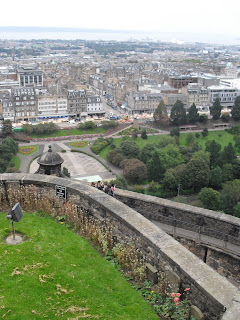
Edinburgh Castle sits high above the city of Edinburgh. How high, you ask, especially Justin's skeptical Pittsburgh relations, whose driveways frequently rate as black diamonds come winter?

That high. I think even Pittsburghers must be impressed.

With the hill, and the commanding view of the water, one can therefore guess that this has been an important defensive position for a significant period of time. One would be correct. Way to go, one! According to the castle web site, the oldest evidence of human settlement on the castle hilltop dates back to 900 BC, with the fortress "Din Eidyn" ("Edwin's Fort") first appearing around 600 BC.

(Side note to Tolkein nerds: Din Eidyn... Dunedain. Warrior men of the North. Make your own call).

The oldest building on site, going back to 1130, is St. Margaret's Chapel, a tiny whitewashed stone room dedicated to the former queen of Scotland. You can just make it out on the far right of this image here. See how the texture of the stone is rougher?


Nearby you can find Mons Meg, a 550 year old medieval siege gun built at Mons, Belgium, and quite frankly not something I would have liked to have had to lug up the hill. I am, however, perfectly happy to pose around it in various undignified ways.


Nor would I have liked to have lugged the ammunition.


The castle was the site of several important battles during what Americans best know as "the Braveheart period," AKA the reign of Edwards I through III. (As our tour guide at the castle put it, "There are three types of movies: movies which tell the history, movies which are based on the history but take some liberties, and movies which make no attempt at historical accuracy whatsoever. Braveheart falls into the third category.") The relevance of the castle at this time is demonstrated by the following text from the castle web site:
1296
Edward I of England invades Scotland, capturing the
castle after a three-day siege.

1314
The Scots, under Robert the Bruce, recapture the castle.

1334
The English retake the castle.

1341
The Scots take it back again.
If I recall correctly, at least one of these sieges involved people boiling human waste to fling down on the enemy at the castle gates. Hey, why waste oil or pitch?
The Great Hall was built in 1511. Justin and I spent most of the time in there having flashbacks to Yale College dining halls, and wondering if we had remembered to swipe our meal cards.


(That's Edinburgh Castle at the top, Yale below).

King James I of England (James VI of Scotland, which, let's face it, is pretty irritating to keep track of) was born at the castle, in a tiny little chamber which we did not photograph, as indoor photography is frowned upon. It was tiny, and entirely paneled in painted wood, with a nice view down off the hill that I bet his mother Mary got awfully tired of while stuck in there in labor.

As they did at many UK historical sites, the Victorians took it upon themselves to improve upon the original. Here, you can see how a medieval wall becomes, halfway up, a Victorian addition:

The castle is also home to the Scottish National War Memorial


and the Honours (with a U!) of Scotland, which in English means the crown, sceptre (not scepter!), and sword of the monarchs of Scotland, along with some really nice royal jewelry. It is an interesting quirk of history, I think, that Scotland maintained its independence in the wake of the wars mentioned above - the not-really Braveheart wars. It was only after James VI went over to become James I (I told you that would be annoying) that the shenanigans started. You would think that a Scottish family on the throne of England would be good news for the Scots, but alas, it was not to be. (Although in all fairness, you could probably say that the problems really began when the Scottish family came off the throne; see Justin's earlier post for review. There will be a quiz.)


Yes, that's me in the lower right. Do you think I would make a good guard? See how vigilant I am!
On second thought, no. It was too cold.

27 September 2009

Over the Sea to Skye

A much-belated revisitation of our trip to the Highlands, also discussed here, here and here.

The Isle of Skye is a much-romanticized part of the Highlands due to its role in the '45 uprising (what, weren't you paying attention to Justin's post? He worked hard on that!). Flora Macdonald, a Highland Jacobite lady, was engaged to help Bonnie Prince Charlie escape from Scotland by taking him in a boat "over the sea to Skye," as described in the famous Skye Boat Song.

(You can get more insight into the romanticism of the '45 if you click on the video, which is "dedicated to Jacobites everywhere." What does that even mean? How can you be a Jacobite these days? Are you going to go get Franz, Duke of Bavaria and try to put him on the throne - over his own indifference? I get that in many cases, Jacobitism is conflated with Scottish nationalism or Scottish patriotism, but it's just not correct. As Justin pointed out in his post, more Scots fought against Charlie than for him. Anyway, if, like me, you're not a fan of historical whitewashing, just try to concentrate on the fact that Charlie made his escape in drag, as Flora's Irish maid Betty Burke. Surely one of the great examples of monarchical transvestitism.)

Ahem. Focus.

Skye is a four-hour round-trip day-trip from Inverness and allowed us to see some beautiful scenery on the way. It was also a day in which the winds were so heavy that the ferries to Skye were cancelled (we took the bridge, fortunately) which explains our hair in this, and subsequent, pictures:


Once on the island, we visited the Clan Macdonald center, the Armadale Castle Gardens and Museum of the Isles. My only complaint about this day trip was that with Justin and my penchant for nerding, we spent so much time in the museum that we didn't actually have time to eat any lunch on Skye. Fortunately, we brought granola. We're like hardcore hikers, but for museums.

Armadale Castle ruins (that's me in the pink hat)


I strongly recommend the museum. It had very interesting regional history exhibits, often in both Scottish Gaelic and English. Gaelic (pronounced "Gallic" for the Scottish version; same root as "Gaul" for France) was the indigenous Celtic language of Scotland. It's closely related to Irish Gaelic and more distantly related to Welsh, which is the only Celtic language to be very widely spoken. There are 50,000-odd speakers of Scots Gaelic today, contrasted with about 1/2 million for Welsh. These speakers are disproportionately concentrated in the northwest of Scotland and the islands, where their isolation has helped shield them from English. Skye is the island about 1/3 of the way down that map, with a bright purple top tip. The Scottish Gaelic Language College is on Skye, as is a new Gaelic elementary school. Another new one just opened in Inverness. Since regaining some parliamentary powers in 1999, Scotland has been able to leverage some protection for Scots Gaelic, including a broadcast channel in Gaelic on the BBC; however, 50,000 speakers is right on the cusp of the number needed to prevent language extinction. Nobody can say for sure if Gaelic will survive.

Educational trivia about Skye: There is only one high school, Portree High School. It can be so far from students' homes that the students commute to school on Monday and stay in a hostel for the rest of the week.

Pet peeve rant: I have been endlessly amused by the usage across Scotland of what I perceive as schlocky faux-Celtic fonts like the ones on the Portree web site. In the US, it's the sort of thing you'd see at cheesy Irish pubs like Molly Brannigan's. I have NOT been amused by the omnipresence of the font Papyrus. I see it probably every other block. There is not, nor has there ever been, widespread use of papyrus to make paper anywhere in the British Isles. Get a new font.

Skye has some typical Highland scenery, down to the little white dots of sheep:


But it also has massively damp, lush areas straight out of Jurassic Park:


Other events of the afternoon involved whisky tasting. The MacNamaras are from Skye; Justin is part MacNamara.


NOOOOOOOO! CURSE YOU, PAPYRUS!!!

We also visited a beach....


... the ruined castle shown the TV series Highlander...


... and a lovely scenic bridge. Justin looks odd because he's trying to talk the photographer into stepping out of traffic. But wait! What's that in the background? Click to zoom!

The photographer said, "I hope that's your wife." Some days, Justin probably hopes it's not!