Showing posts with label Victorian. Show all posts

03 June 2010

London Museums, Part One: Science, Natural History, and the British Library


London is a museum junkie's paradise: the city is home to nearly a dozen world-class museums . . . and nearly all of them are free! What's more, any one of London's mega-museums is simply too huge to cover in one visit, let alone in one section of a blog post, so what you'll find below are just the highlights. Enjoy!

Science Museum

The Science Museum is one of a cluster of enormous museums on Exhibition Road in South Kensington--it shares a block with the Natural History Museum (see below) and the Victoria and Albert Museum (upcoming post).

For the most part, the Science Museum is a pretty typical sort of "science center," with interactive exhibits on things like physics, astronomy, space travel, and such. For Nana and me, what made the Science Museum unique were its two historical exhibits.
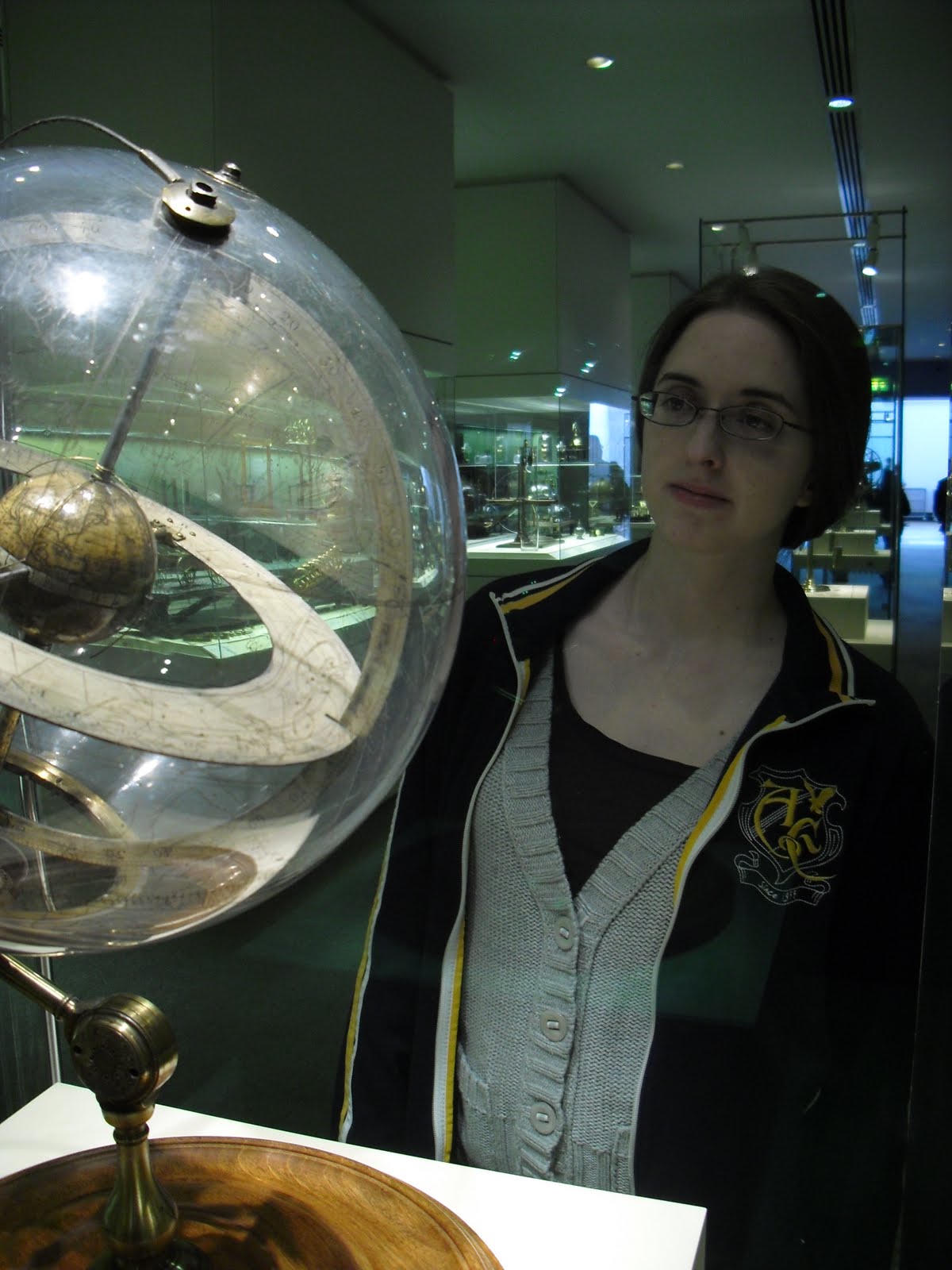
One of these was a large collection of 18th-century scientific equipment, such as the orrery you see above. (An orrery is a device for modeling the motion of the Earth and the solar system.) The collection included many items intended more for display--one might even say performance--than for active experimentation, as one of the great legacies of science in the 18th century was its increasing popularization. In a sense, these items represented the "science museums" of two-and-a-half centuries ago.

The other historical exhibit (too dim for photos, I'm afraid) was on the Golden Age of Islam. During this period, from roughly 750 AD to the Sack of Baghdad in 1258, scholars in the Middle East, North Africa, and Muslim Spain made major contributions to knowledge in general, and especially to science in particular. In fact, many aspects of the scientific method itself can be traced back to these scholars, and their names live on in words such as, for example, "algebra" and "algorithm," just to name a few.

Natural History Museum

The Natural History Museum is famous for two things: architecture and dinosaurs. 

Architecture first. The Natural History Museum is sometimes called a "cathedral of nature," and rightfully so, it is housed in a remarkable Victorian behemoth of a space.


The interior is just as impressive as the exterior, with high vaulted ceilings, echoing hallways, and loads of unexpected detail, like the carving below.

Like most of London's museums, the Natural History Museum would take several days to explore fully. We naturally blew right past the geology exhibits . . .

. . . and headed straight for the dinosaurs. As expected, the dinosaur rooms were swarming with giddy schoolchildren, and probably out of consideration for these guests, most of the skeletons on display were reproductions. But all those little smiles disappeared when confronted with the museum's life-sized animatronic T-rex ("life-sized animatronic T-rex" being the coolest phrase you'll read today).

Just. Awesome.

British Library

The British Library in St. Pancras is, first and foremost, a research library--one of the world's greatest, at that. But like most research libraries, they also have a small exhibition space for showing off the collection. Given that, a) I love books, and b) I love maps, the decision to spend an hour at the BL's "Magnificent Maps" exhibit.

I'll spare you a long lecture (maybe Nana the geography teacher will want to chime in with a comment) and just tell you that you can see a couple highlights on the exhibition website, including a fantastic medieval world-map with east at the top and Jerusalem at the center and a fanciful modern map imagining London as a vast urban island. Very cool!

04 May 2010

Scone Palace: The Stone of Scone

(Scone, by the way, is pronounced "skoon" by the guides at Edinburgh Castle but "scohn" by my Shetlander friend - see here for more on accents)

Scone Palace, which I briefly mentioned before, belongs to the Earl of Mansfield. It's a 19th century building on the site of the old Scone Abbey. General rule of thumb when dealing with British architecture: if it looks the way you think something medieval should look, it's 19th century (and usually Victorian). Genuinely medieval things are, for the most part, ruins.

The interior at the Palace (technically more of a manor house, but that doesn't draw the tourists) is quite interesting and a fun visit. You can see the chamber where Queen Victoria slept, a remarkable collection of ivories and porcelains, and pictures of the family past and present. You can't take photographs inside, however, so we just have some shots of the grounds.

The kings of Scotland were traditionally crowned at the former Abbey while seated on the Stone of Scone, reputed to be Jacob's pillow from the Bible. It's also called the Stone of Destiny, which I always hear in my mind in the same squeaky voice as the pigs from Babe saying "PIG..... OF..... DESSTINYYYYY." But we already know I have problems.

"Stone of Destiny" is "Lia Fail" in Gaelic, and, as many Scottish icons do, has a beer named after it. (Justin's verdict for said beer. which he sampled last fall - "Meh.")

In any case, in 1296, the English King Edward I (the bad guy from Braveheart) pilfered the Stone and took it back to England as part of his campaign to subdue the Scots. No crowning stone, no crowned king, as the logic went.

According to my grandfather's genealogy research, my family is vaguely descended from Edward I. Blood, as they say, will out, and overcome by family tradition, I attempted to make off with the replica Stone.

I may have been more authentic than I knew, as my great-great-whatever-grandfather may also have targeted a replica. It is said that Edward's stolen Stone was a substitute, sneaked into Scone by Scottish subversives, while Scone Abbey monks secretly submerged the original in the River Tay.

The Stone generally believed to be the original resides today at Edinburgh Castle, but it has been a bit of a circuitous journey. It was lodged in a chair used in the English coronation ceremony at Westminster Abbey, thereby integrating (or coopting, depending on your point of view) the Scottish tradition for the joint monarch of England and Scotland after the 1707 Act of Union. It remained there until the 1950s, when radical students stole it, but eventually gave it back. There's a move about this called Stone of Destiny; for trivia buffs, it stars not only Billy Boyd, but also Kate Mara, descended from the American families which own the Steelers and the New York Giants.

The Stone finally made it back to Scotland in 1996 in what the Edinburgh Castle tour guides describe as a failed attempt by the Conservative Party to buy off Scottish voters. The agreement states that the stone will be loaned back to Westminster for the next royal coronation; Scots like to joke that they will send it back tied to a string.

Here in the cafe beneath the palace, Justin consumes a scone. A Scone of Scone. (Justin's verdict: "6.5/10. I prefer crumbly. The jam was good, though.")

We're pretty sure this means that Justin is now the king of Scotland.

20 December 2009

Stirling: the Church of the Holy Rude, Argyll's Lodging, Mar's Wark, and more!

Earlier this week, Nana and I took a day trip to nearby Stirling, home of Stirling Castle (previous post). Stirling is more than just a castle, though, and the city's ample historical markers make the whole Old Town like an outdoor museum. In this post, we'll take a look at some of the Old Town's other sites.

Mar's Wark and the Erskine Church

Our first stop was Mar's Wark, a ruined 16th-century townhome built by one of the Earls of Mar, who were of the Erskine clan, making them Nana's distant distant relatives. The resemblance is uncanny.


The Earls of Mar were the keepers (stewards, basically) of Stirling Castle; this particular earl had also been the Regent of Scotland while James VI was growing up. He was a powerful dude.

The house itself would have been magnificent in its heyday. It had enormous windows with splendid views, ornate stone carvings (check out the mermaids below), and a prime location right between the Church of the Holy Rude and the castle.


Mar's Wark fell into disrepair after one of the later earls forfeited the home by supporting the Jacobites in 1715. The home was used as a barracks during the 1745 Jacobite Rising and suffered considerable damage during that conflict.


But 1715 wasn't the end of the Erskines in Stirling: in 1733, one Ebenezer Erskine, a radical Presbyterian, broke away from the Church of Scotland and established his own church just down the street from the Church of the Holy Rude. The original Erskine Church was replaced by a newer structure of the same name in 1825. Now, the building is a youth hostel.

Church of the Holy Rude

The Church of the Holy Rude has been Stirling's parish church for nearly 900 years. The name features the Scots version of the English "rood," referring to the cross. James VI was crowned here in 1567, making the Church of the Holy Rude one of only two still-operating churches in Britain that have been host to a coronation.


The Church is also the site of an impressive kirkyard, dating mostly from the 19th century. In the left background of the shot above, you can see the back of Mar's Wark.


Argyll's Lodging
Argyll's Lodging, literally a stone's throw away from Mar's Wark, is a well-preserved and partially restored 17th-century townhouse. The current building is the result of the 9th Earl of Argyll's expansion of an existing L-shaped tower house in the 1670s.

That tower house had belonged to William Alexander, 1st Earl of Stirling, the man behind Scotland's first (failed) colonies in Nova Scotia, and also the progenitor of Nova Scotia's name, flag, and coat of arms. You can see a version of that coat of arms over the door below: the design features a Native American on the left and a mermaid on the right. This motif appears again a few other times throughout the house.


Argyll's renovations demonstrate the man's devotion to French design. For example, his house featured what it generally believed to be the first wooden staircase in Scotland. Argyll also made extensive use of the newfangled drop-leaf tables you see in the picture below.


Now, these days drop-leaf tables usually say "I live in a tiny apartment and I shop at Ikea." In Argyll's day, they said "The heck with this, let's dance!" You see, judicious application of drop-leaf technology could turn your average dining room into a dance hall in seconds flat.

 
Today, Argyll's Lodging is managed by Historic Scotland as part of the Stirling Castle property. One ticket lets you visit both sites.

Old Town Jail

If there's anything Victorians love more than anachronistic Gothic-style architecture, it's repressing people for their own good. So it's not surprising that the leaders of Victorian Stirling poured time and money into a new-model jail/insane asylum/poorhouse shaped vaguely like a medieval castle.


These days, the Old Town Jail is a kid-centered tourist attraction featuring dozens of historical re-enactors. It was closed for renovations during our visit, but the jail's grounds allow for a pleasant stroll.

Of course, even though we were only at the jail for ten minutes, Nana couldn't help running afoul of the law. 


24 November 2009

Robert Smail's Printing Works, Innerleithen

Wow, two posts in 24 hours! Don't get too used to it: we've got a bit of a backlog, so we're trying to catch up.

Anyway, last Wednesday Nana and I took a field trip with my book history program to Robert Smail's Printing Works, in Innerleithen, in the Borders.

Robert Smail's, a National Trust for Scotland property, is a working 19th-century print shop and stationery store that doubles as an industrial heritage museum. The property owns and operates an iron hand press and a variety of later-19th-century powered presses. They still do jobbing work--posters, tickets, brochures, etc--but most of their revenue these days comes from visitors like us.

Now, as a book history dork, I could go on for hours about all the details of how work got done in this kind of shop, but I'll spare you. (Though I'd be happy to elaborate if asked.)

The basic process is this:
  1. Arrange all the bits of type you want to show up on the page in a big rack called a forme--this is called "compositing."
  2. Stick the forme (or a copy of the forme called a stereotype) in the press.
  3. Insert paper; ink the stuff on the form; impress; lather, rinse, repeat as needed.
  4. Fold, cut, bind the finished product; clean and maintain the machine; put the type back where it belongs.
  5. Profit.

At Smail's, you can watch just about every step of the process except the fourth (you get to watch step five in the gift shop!). But you actually get to do step one in the compositor's room, where visitors compose their names (upside-down and backwards) and have them printed on a little keepsake bookmark.


The highlight of the tour: I got to use a special "ff" for my name!

That little thing I'm holding is called a "compositor's stick," or just plan "stick." You put the type line-by-line into the stick first before putting it into the forme.

The second highlight, though, was the machine room, where the heavy-duty stuff is kept. The machines still in use included a wacky pedal-powered clamshell press, an enormous old cylindrical poster-printer, and a blisteringly fast German windmill auto-feeder. None of which terms made any sense to me until I saw them in action! Alas, I forgot my memory card, so I only have this picture to share, which shows the pedal-powered clamshell in the lower-left and one of the older auto-feeders in the upper-left.


The machine room also included a paper guillotine that can easily cut through a stack of paper as thick as your arm in one swipe. Yikes.

In any case, the day was full of fun facts. It turns out that several English idioms come from printer's jargon: out of sorts, for example, means that one or more of the boxes (aka, "sorts") in your typecase is empty. Upper case and lower case, of course, come from the fact that capital letters were kept in the top half of the typecase, and when you're taking type off the form and sorting it back into the case, it's important to mind your p's and q's, as those letters are almost identical in most fonts.

On the whole, the trip made for a very fun day, and I'd definitely recommend a trip to a print shop if there's one near you. It's fascinating how easy it is to ignore how what we read is put together!

17 November 2009

Sartorial Mythbusting, Part 1: Clan Tartans

When you think of Scotland, you probably think of many things. Haggis. Bagpipes. Rain. But I'm going to go out on a limb here and guess that your most thought-of Scotland image is tartan, often also called plaid.

Ah, the tartan! What a glorious tradition, each clan to its own tartan! Imagine them running over Culloden Field in their Highland Charge, displaying to the enemy which families were arrayed against them! How tragic it was when the plaids were banned for most of the rest of the 18th century!

Except not. Time for some sartorial (i.e., clothing) mythbusting!

Here is a portrait of John Campbell, from 1749:

We have a problem here. The Campbell plaid, as we know it, is predominantly blue, green, and white, and looks like this.
So he is definitely not wearing Campbell plaid. (In fact, he's wearing two plaids that aren't "Campbell plaid" – your eyes may be watering too hard from that outfit to tell, but those tartans are different top and bottom). Why not?
Campbell plaids did not exist in the 18th century. Neither did Stewart plaids, or MacDonald plaids, or MacIntosh plaids, or any other form of official standardized clan plaids. There were very likely regional variations caused by the availabilities of dyes and local weaving techniques, but the official tartans as we know them are a product of the early 19th century, specifically of a firm called Wilson's of Bannockburn.
At that time, Scotland was hot. Highland regiments won renown for their fighting against Napoleon. Sir Walter Scott's 1814 book Waverley romanticized the '45 uprising like dang and whoa. King George IV even came to Scotland in 1822, and wore tartan! Wilson's knew a good trend when they saw it, and began weaving like crazy on those newfangled industrial looms. This, by the way, is another nail in the coffin for the "plaids as traditional Highland attire" argument – the plaids we see today are completely beyond the capacity of a Highland homespinner, both in weaving and dyeing. (Want to try some virtual weaving yourself? See links below!)
Soon, Wilson's's ('s's's's) tartans were flying off the shelves. To keep track of all the patterns, or perhaps to simply merchandise them better, the tartans were given clan names. The final capping touch on this was the forgery of the Vestiarium Scoticum (a book, and not a skin condition, although it sounds like one) by John Sobieski Stuart and Charles Edward Stuart, two brothers who claimed to be the descendents of Bonnie Prince Charlie. The book, which they said came from an old manuscript, claimed to lay out pre-Culloden tartans by clan. As fake royals trying to bond with the local population and score some freebies like room and board, the Sobieski Stuarts probably claimed this faux sartorial (word of the day!) expertise to shore up their Scottish street cred.
Need more evidence? Look at the 1746 David Morier painting of Culloden, in which the Scots clearly are not wearing organized plaids. The tartans shown also do not align to the 19th century plaids assigned to the clans we know were at the battle. (There are also some more amazingly eyewatering tartan-on-tartan outfits here – I'm surprised the Hanoverian side could see to aim their muskets.) Eyewitness accounts of the battle support the painting as well. The Jacobites were distinguished by white bonnets, or the berets with white bows shown in the painting. After the battle was lost, the vanquished frequently ditched the bonnet to pass for Royalists. Clearly, this would not have worked if the other 8/10ths of your outfit screamed "Member of a Jacobite Clan."
Some people don't deal well with this revelation. My professor recounted giving a presentation on the above portrait of Campbell and receiving a question from a man who wanted to point out to her that it couldn't be John Campbell, since it wasn't a Campbell plaid. She explained what I've just gone over here – that the "Campbell plaid" is 19th century construction, etc., etc., and he nodded and nodded, and when she finished, he said, "I understand what you're saying, Professor, but that's not a Campbell plaid." The tourist industry also is very fond of the tartan system, as it enables them to sell mass quantities to Scottish diaspora tourists seeking a bit of heritage to take back. (Which is completely fine with me - the tartan can still connect you to Scottish heritage, or to other wearers, or can just look fun, regardless of what year it was designed. I like tartan. I just want to point out its real history.)
Nowadays, tartans are policed very seriously by the Scottish Register of Tartans, which you can think of as a patent bureau for tartan patterns. If you made a tartan using Tartan Maker or Tartan Designer or Interactive Weaver (go on, it's a hoot) or another progam, I'm sorry to say you can't just declare it your tartan and start making kilts. You must submit it (and pay a fee), and have your submission approved as different enough from all existing tartans to justify its own registration. With everyone from Alberta to Zambia getting in on the act, you can imagine things get tighter every year.
By "policed," though, I don't mean that people will come and tear a tartan off you if they don't you deserve it. Mostly it relates to manufacture and naming rights. People "in the know" would frown on wearing the royal family's three Balmoral tartans if you're not actually a royal (they won't even manufacture them for you in the UK), but tartan-wearing is basically self-policing. If you want to wear one just because you like it, I don't think people would mind. Just don't lie and say you're their long-lost cousin
Coming up next time: the "banning" of the Tartans, and what is a plaid?