
One of our readers posed an interesting question in an e-mail to the two of us today, which in true grad student fashion I took as a cue to pen a huge missive that tried to cover the whole history of the book in the Western world in one go.
I'm posting my response here because whenever I tell people I'm studying book history, they usually have no idea what that means, but after I talk about it a little, they perk up, usually because they realize how pertinent the questions book historians ask are to the present day.
The e-mail in question, in describing the book as a technology (which one of the many approaches book historians take), first asked what the Romans meant when they said "liber" (the root of "library"), then raised the question of what the internet will do to books and periodicals in their printed forms. Here was my shamefully long response:
The book (codex) as we know it dates from Roman times. Somewhat apocryphally, its invention is attributed to Julius Caesar, who used little booklets of parchment (papyrus doesn't fold easily) for sending messages--in booklet form, you could conserve parchment by writing on both sides, and the message was easier to conceal and carry. The codex really caught on among Christians--this was the first time you had readers of a low-enough class that they had to worry about conserving parchment. Plus, the codex scriptures were easier to smuggle, and they made cross-reference easier.
The printing press, of course, caused scribes to freak out, but it also caused great consternation among the elite readers of the late manuscript age, who worried about the possible political effects of widespread, relatively cheap print. They also worried that print would allow too many authors and too many books to be preserved--an early fear of information overload.
Then, in the late 18th and early 19th centuries, the boom in literacy and letter writing, the piecemeal introduction of cheap postal service throughout Europe, the spread of periodicals across class lines, the end of perpetual copyright, and the increased commercialization and industrialization of the publishing industry, sparked an information revolution with some striking similarities to what we're seeing now. By the late 19th century, in England at least, nearly everyone was literate, nearly everyone kept up correspondence with people throughout the country and even throughout the empire, there were enough publication venues available that a large number of amateurs could participate in the public debate, and there was simply so much text out there that no one had near enough time to read everything they wanted to read.
During this time, the London publishing companies fought long and hard to stave off the collapse of their old business model (selling extremely expensive, well-made books, in small print runs, to private and public libraries), and only gave in when a) they realized people who couldn't afford books were simply borrowing them from libraries and friends and copying their favorite passages out longhand, and b) they couldn't compete with the cheap editions pouring in from Ireland and Scotland, or with the cheap serials and periodicals being published throughout the Isles. Quite a few old-model London publishers failed--the ones that still survive from that time (Routledge, Macmillan) were the ones who adapted and moved downmarket with a publishing model still in use today: bring out an expensive edition (like hardback) for the libraries and the early-adopters, then a cheaper edition (like paperback) for the majority of readers. The most successful writers were the ones who adapted to the new technology of the periodicals--journalists, and fiction writers who would syndicate their novels. The most successful literary men of all--the new professional agents--were the ones who developed expertise in the complicated new markets created by these new technologies.
I think this is partly why I'm interested in studying the "long 19th century" (1780-1910ish): it's a period of extremely rapid and near-total transformation in how (and which) people read and write, not unlike our own. Parallels abound: e-mail vs. cheap postal service; web magazines, blogs, vs. old periodicals; the three-volume novel vs. the DVD (both of which circulate mainly through rental, and both of which spawned cheap, pirated versions). In the 19th century, some formats and some business models died as a result of the new technology--the three-volume novel, the patronage system of author support, the annual and quarterly volumes of reviews--while some new formats and business models arose in their places--the inexpensive one-volume novel, professional commercial authorship, weeklies and dailies.
Some won, some lost, but on the whole I think we came out ahead: more readers representing a wider slice of society, more reading material, more democratic participation in the public sphere. I think the same is happening now. The new technologies are better for some uses: for example, I don't think anyone needs to write legibly anymore, as long as they can read their own handwriting--we type or speak most communication with others today. Most periodicals don't lose much, and in fact gain a lot, in digital format. I'd say the same for reference materials.
But I still think books are the best tool available for research or cross-reference: the computer screen is basically a scroll, and anyone who has tried to flip through different parts of a PDF (curse you, end notes!) knows what a disaster that can be. Books also work off the grid (a lot of us are too clumsy to take a Kindle anywhere near a bathtub), and the whole display element of owning books is lost in digital formats. Finally, as a firm believer in writing in books, I don't plan on giving the codex up anytime soon. But the newspaper? Online. News television? Online. Reference sources, databases, and archival information? Online. But Jane Austen? Dan Brown? Carla Kelly? The Bible? Sure, digital forms will peel some of the buyers away, but I have a feeling the codex forms will stick around.
Of course, one of the great things about studying book history (as opposed to old-school English lit) is that the people you talk to often have opinions on what you study, because these questions actually touch every literate person's life everyday. So: what do you think? Will the internet kill the book? Wound it? Destroy civilization as we know it?
09 October 2009


07 October 2009
Getting Schooled: The First Few Weeks
It hadn't occurred to me until the other day, when my mom asked me how school was going, that we've barely posted anything about our studies on the blog. I'm not sure why--maybe we just got into the habit in our last job of keeping our professional and personal lives mostly separate (the old blog was a personal space), or maybe we've just been so caught up in the first few weeks of the term that we've been too burned out to write about it. Probably a little bit of both.
Anyway, I'm here to remedy that.
First, grad students in general frequently complain about either a) how hard you have to work in graduate school, or b) how hard it is to work hard when you don't have people telling you what to do all the time. I think spending the last two years as a full-time teacher has helped. 50+ hours per week was pretty much the minimum last year, and Nana and I were tasked with structuring the academic years of 40+ students. Compared to that, taking responsibility for one student doesn't seem like such a big deal.
That said, we have been working pretty hard. For example: two weeks ago, as part of my program's standard research methods course, I was given about 72-hours to complete a "bibliographical assignment" that included a complete prospectus, syllabus, and annotated bibliography for an imaginary seminar entitled "The Scottish Fiction Market: 1800-1900." Such assignments are generally designed as crash courses in research. They take a sink-or-swim approach--there's no way to complete them in the time given without making yourself very, very familiar with the local libraries, the relevant search engines, etc. It also forces you into efficient reading, which is good, since I have a tendency to read . . . very . . . slowly. . .
Since then, I've roughly split time between preparing for classes and beginning background reading for possible essay topics. I'm in two courses: "Cultures of the Book," my core course, which covers a wide range of book history topics from ancient times right through to the present; and "The Literature Industry," which focuses on the production and consumption of books in the 19th century.
For "Cultures," I'm tentatively planning to write on some aspect of how readers get the most out of limited reading time (for example, how readers in the 18th & 19th centuries used reviews as substitutes for books). For "Industry," I'm thinking of writing on Elizabeth Gaskell's biography of Charlotte Brontë.
Beyond that, I don't quite know what more to say, though I'm certainly open to suggestions. If you've got any burning questions, either about the stuff I'm studying, or about what studying in Scotland is like, ask! and ye shall receive a rambling blog post in reply (which may or may not contain a satisfactory answer).
03 October 2009
Nana and the Giant Hedge
This was supposed to go up a while ago, as part of our post on the Royal Botanical Gardens, but I forgot. So here you have it, without further ado: Nana and the GIANT HEDGE.


Truly one of the world's great hedges.
01 October 2009
The Field of Storms and The Black Isle
At last, the final installment of our Highland adventures! You can find the other posts here:
This post is in two parts: the first covers the tiny Highland hamlets of Ledgowan and Achnasheen, which we visited on our way to Skye; the second covers our day trip around the Black Isle, which is actually a peninsula just northeast of Inverness.
Ledgowan and Achnasheen
Our first stop on the Skye day trip was here, in the aptly-named Field of Storms (Gaelic: achnasheen), at the foot of one of the few passes over the spine of the Highlands south of the northern coast and north of Loch Ness.
 Seriously, check out the satellite view on Google Maps: nothing but miles and miles of heather. Achnasheen and Ledgowan are where the little orange road at the bottom forks.
View Larger Map
The prevailing westerly winds howl down through said pass and over Achnasheen fast enough to make a grown man unsteady on his feet. Hence all those trees you see aren't just for decoration: they're there to make it possible to hear yourself think on the way from your door to your car.
Now, having, like most American young men, seen Braveheart about a billion times, I was interested to see how different the Scottish Highlands look from how they're depicted in the film. The Highlands are not actually green--they just filmed mostly in the green bits, and in Ireland.
No, in reality, the highlands are brown and purple (yes, purple, thanks to the heather).


The Black Isle
The Black Isle isn't an island: it's actually a peninsula between the Cromarty Firth and the Moray Firth, just north of Inverness. No one is sure how it got its name--some say it was a late stronghold of witchcraft, some say the forests along its coasts made it look black--but my money's on the place being named after the extremely dark, extremely fertile soil, which made the Black Isle one of the breadbaskets of the Highlands.


Cromarty's restored courthouse is also home to an excellent local history museum.
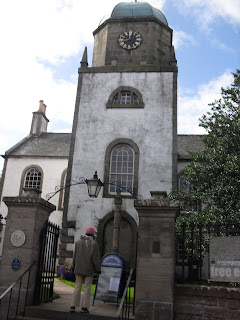


A final word about the Black Isle: it's also home to one of Scotland's foremost microbreweries, the Black Isle Brewery, which produces a line of very tasty organic beers.
This post is in two parts: the first covers the tiny Highland hamlets of Ledgowan and Achnasheen, which we visited on our way to Skye; the second covers our day trip around the Black Isle, which is actually a peninsula just northeast of Inverness.
Ledgowan and Achnasheen
Our first stop on the Skye day trip was here, in the aptly-named Field of Storms (Gaelic: achnasheen), at the foot of one of the few passes over the spine of the Highlands south of the northern coast and north of Loch Ness.

View Larger Map
The prevailing westerly winds howl down through said pass and over Achnasheen fast enough to make a grown man unsteady on his feet. Hence all those trees you see aren't just for decoration: they're there to make it possible to hear yourself think on the way from your door to your car.
Now, having, like most American young men, seen Braveheart about a billion times, I was interested to see how different the Scottish Highlands look from how they're depicted in the film. The Highlands are not actually green--they just filmed mostly in the green bits, and in Ireland.
No, in reality, the highlands are brown and purple (yes, purple, thanks to the heather).


The Highlands (or at least the parts that are actually high) are also remarkably barren, something more like what you'd expect from the American West. There's simply a lot more space than you'd expect to find anywhere in such a small country.
It's worth noting, however, that the Highlands aren't quite a wilderness, in that the Highlands as they are today are largely man-made: the slopes above used to be covered about halfway up with forests of Scots pine, but the earliest settlers (we're talking prehistoric here) clear-cut the place even before Scotland passed into the historical record.
In many of the more sheltered glens, there has been an effort to replant, both for environmental and commercial reasons, but the Field of Storms is largely out of luck thanks to the wind.
The Black Isle
The Black Isle isn't an island: it's actually a peninsula between the Cromarty Firth and the Moray Firth, just north of Inverness. No one is sure how it got its name--some say it was a late stronghold of witchcraft, some say the forests along its coasts made it look black--but my money's on the place being named after the extremely dark, extremely fertile soil, which made the Black Isle one of the breadbaskets of the Highlands.


We toured the Black Isle for a morning in the open top of a double-decker bus, which was terrible for the body temperature, but absolutely perfect for grooving to the Highland tunes they piped in on our audio tour headsets.

Wait, is that . . . ? Yes, it is! The Schecky dance (sp?) in the Highlands!
Our first stop of the morning was at the ruined priory of Beauly (from the French beau lieu), established by Norman monks around 1230.

Beauly Priory is built of the same Old Red Sandstone prominent throughout the Eastern half of the highlands, giving it a distinctly pink hue.
From Beauly, we continued on to Cromarty, an old fishing village at the tip of the Black Isle, where the Cromarty Firth branches off from the Moray Firth. In the background of the picture below are the Sutors of Cromarty, two high bluffs marking the entrance to the Cromarty Firth. Today, the Firth is actually used to store and repair North Sea oil rigs; the narrows by the Sutors keep the waters of the Firth calm year-round.


Cromarty spent most of its history as a royal burgh, which means it had a measure of urban independence from the feudal system, and that it was a designated port for overseas trade, mostly with France and the Low Countries. Unfortunately for her, Nana found all this history altogether too exciting, and had to be chained up in the refurbished jail for creating a public disturbance.

Our final stop of the morning was at Chanonry Point, on the southern coast of the Black Isle. The Moray Firth is home to a large colony of bottlenose dolphins, and the crisscrossing currents between Chanonry Point and Fort George are the colony's favorite feeding grounds. It's supposed to be one of the best spots for viewing wild dolphins in the whole of Europe, and given the show they put on for us, I can't disagree!

The little buggers are pretty hard to photograph, though, so you'll have to take my word for it. We did get to see them up close--no more than fifty yards away--and we even caught a glimpse of one of the local seals.
Chanonry Point is also the site of a very pretty--and still privately owned and operated--lighthouse, which you can see below.

A final word about the Black Isle: it's also home to one of Scotland's foremost microbreweries, the Black Isle Brewery, which produces a line of very tasty organic beers.
27 September 2009
Over the Sea to Skye
A much-belated revisitation of our trip to the Highlands, also discussed here, here and here.
The Isle of Skye is a much-romanticized part of the Highlands due to its role in the '45 uprising (what, weren't you paying attention to Justin's post? He worked hard on that!). Flora Macdonald, a Highland Jacobite lady, was engaged to help Bonnie Prince Charlie escape from Scotland by taking him in a boat "over the sea to Skye," as described in the famous Skye Boat Song.

Once on the island, we visited the Clan Macdonald center, the Armadale Castle Gardens and Museum of the Isles. My only complaint about this day trip was that with Justin and my penchant for nerding, we spent so much time in the museum that we didn't actually have time to eat any lunch on Skye. Fortunately, we brought granola. We're like hardcore hikers, but for museums.
Armadale Castle ruins (that's me in the pink hat)


I strongly recommend the museum. It had very interesting regional history exhibits, often in both Scottish Gaelic and English. Gaelic (pronounced "Gallic" for the Scottish version; same root as "Gaul" for France) was the indigenous Celtic language of Scotland. It's closely related to Irish Gaelic and more distantly related to Welsh, which is the only Celtic language to be very widely spoken. There are 50,000-odd speakers of Scots Gaelic today, contrasted with about 1/2 million for Welsh. These speakers are disproportionately concentrated in the northwest of Scotland and the islands, where their isolation has helped shield them from English. Skye is the island about 1/3 of the way down that map, with a bright purple top tip. The Scottish Gaelic Language College is on Skye, as is a new Gaelic elementary school. Another new one just opened in Inverness. Since regaining some parliamentary powers in 1999, Scotland has been able to leverage some protection for Scots Gaelic, including a broadcast channel in Gaelic on the BBC; however, 50,000 speakers is right on the cusp of the number needed to prevent language extinction. Nobody can say for sure if Gaelic will survive.
Educational trivia about Skye: There is only one high school, Portree High School. It can be so far from students' homes that the students commute to school on Monday and stay in a hostel for the rest of the week.
Pet peeve rant: I have been endlessly amused by the usage across Scotland of what I perceive as schlocky faux-Celtic fonts like the ones on the Portree web site. In the US, it's the sort of thing you'd see at cheesy Irish pubs like Molly Brannigan's. I have NOT been amused by the omnipresence of the font Papyrus. I see it probably every other block. There is not, nor has there ever been, widespread use of papyrus to make paper anywhere in the British Isles. Get a new font.
Skye has some typical Highland scenery, down to the little white dots of sheep:

But it also has massively damp, lush areas straight out of Jurassic Park:

Other events of the afternoon involved whisky tasting. The MacNamaras are from Skye; Justin is part MacNamara.

NOOOOOOOO! CURSE YOU, PAPYRUS!!!
 We also visited a beach....

... the ruined castle shown the TV series Highlander...

... and a lovely scenic bridge. Justin looks odd because he's trying to talk the photographer into stepping out of traffic. But wait! What's that in the background? Click to zoom!

The photographer said, "I hope that's your wife." Some days, Justin probably hopes it's not!
The Isle of Skye is a much-romanticized part of the Highlands due to its role in the '45 uprising (what, weren't you paying attention to Justin's post? He worked hard on that!). Flora Macdonald, a Highland Jacobite lady, was engaged to help Bonnie Prince Charlie escape from Scotland by taking him in a boat "over the sea to Skye," as described in the famous Skye Boat Song.
(You can get more insight into the romanticism of the '45 if you click on the video, which is "dedicated to Jacobites everywhere." What does that even mean? How can you be a Jacobite these days? Are you going to go get Franz, Duke of Bavaria and try to put him on the throne - over his own indifference? I get that in many cases, Jacobitism is conflated with Scottish nationalism or Scottish patriotism, but it's just not correct. As Justin pointed out in his post, more Scots fought against Charlie than for him. Anyway, if, like me, you're not a fan of historical whitewashing, just try to concentrate on the fact that Charlie made his escape in drag, as Flora's Irish maid Betty Burke. Surely one of the great examples of monarchical transvestitism.)
Ahem. Focus.
Skye is a four-hour round-trip day-trip from Inverness and allowed us to see some beautiful scenery on the way. It was also a day in which the winds were so heavy that the ferries to Skye were cancelled (we took the bridge, fortunately) which explains our hair in this, and subsequent, pictures:

Once on the island, we visited the Clan Macdonald center, the Armadale Castle Gardens and Museum of the Isles. My only complaint about this day trip was that with Justin and my penchant for nerding, we spent so much time in the museum that we didn't actually have time to eat any lunch on Skye. Fortunately, we brought granola. We're like hardcore hikers, but for museums.
Armadale Castle ruins (that's me in the pink hat)


I strongly recommend the museum. It had very interesting regional history exhibits, often in both Scottish Gaelic and English. Gaelic (pronounced "Gallic" for the Scottish version; same root as "Gaul" for France) was the indigenous Celtic language of Scotland. It's closely related to Irish Gaelic and more distantly related to Welsh, which is the only Celtic language to be very widely spoken. There are 50,000-odd speakers of Scots Gaelic today, contrasted with about 1/2 million for Welsh. These speakers are disproportionately concentrated in the northwest of Scotland and the islands, where their isolation has helped shield them from English. Skye is the island about 1/3 of the way down that map, with a bright purple top tip. The Scottish Gaelic Language College is on Skye, as is a new Gaelic elementary school. Another new one just opened in Inverness. Since regaining some parliamentary powers in 1999, Scotland has been able to leverage some protection for Scots Gaelic, including a broadcast channel in Gaelic on the BBC; however, 50,000 speakers is right on the cusp of the number needed to prevent language extinction. Nobody can say for sure if Gaelic will survive.
Educational trivia about Skye: There is only one high school, Portree High School. It can be so far from students' homes that the students commute to school on Monday and stay in a hostel for the rest of the week.
Pet peeve rant: I have been endlessly amused by the usage across Scotland of what I perceive as schlocky faux-Celtic fonts like the ones on the Portree web site. In the US, it's the sort of thing you'd see at cheesy Irish pubs like Molly Brannigan's. I have NOT been amused by the omnipresence of the font Papyrus. I see it probably every other block. There is not, nor has there ever been, widespread use of papyrus to make paper anywhere in the British Isles. Get a new font.
Skye has some typical Highland scenery, down to the little white dots of sheep:

But it also has massively damp, lush areas straight out of Jurassic Park:

Other events of the afternoon involved whisky tasting. The MacNamaras are from Skye; Justin is part MacNamara.

NOOOOOOOO! CURSE YOU, PAPYRUS!!!
 We also visited a beach....

... the ruined castle shown the TV series Highlander...

... and a lovely scenic bridge. Justin looks odd because he's trying to talk the photographer into stepping out of traffic. But wait! What's that in the background? Click to zoom!

The photographer said, "I hope that's your wife." Some days, Justin probably hopes it's not!
Subscribe to:
Posts (Atom)


